Tech
Product photography pricing in 2026: traditional vs. AI costs


Product photography typically costs $25-$75 per standard white-background image and $150-$500+ per styled lifestyle photo, while a full production day can take $800-$2,500 for standard ecommerce needs or $1,500-$5,000+ for creative brand shoots.
In turn, AI product photography service can be up to 80-90% cheaper when accurate source images are available, although costs vary by volume, complexity, and quality control.
In this article, we’ll break down product photography pricing, hidden costs, AI and traditional production budgets, and how to choose the right option for your catalog.
Product photography cost at a glance
Let’s take a look at cost estimates for different types of product visuals.
| Production method | Typical price | Best for | Main tradeoff |
|---|---|---|---|
| Ecommerce studio | $25-$75 per image | Packshots and standard product pages | Products must be shipped and scheduled |
| Styled lifestyle photography | $150-$500+ per image | Campaigns, PDP galleries, ads, and social | Props, sets, styling, and retouching raise the cost |
| Full ecommerce or brand shoot | $800-$5,000+ per day | Complex shoots with several setups | Final cost depends on what the crew completes |
| Short product videos | $200-$1,000+ per video | Product demos, ads, marketplaces, and social media | Motion, editing, sound, and multiple formats increase production cost |
| AI product photography service | $2-10 per 2K image; $5-20 per 5-second video | Catalog expansion, lifestyle variants, localization, and ongoing content | Requires accurate source images and a defined review process |
Need custom photo and video production?
Claid can build an AI pipeline around your requirements and brand aesthetic.
What do product photography services charge?
Before producing your photos, understand how each option is priced: studios charge by time, product, or approved image; self-serve AI varies by plan, output, resolution, and revisions; while managed AI services also cover creative direction, production, QA, and delivery.
With physical photography, there are four common ways to price it:
Per image
You pay for each approved, finished photo. This is usually the easiest model to compare because the deliverable is clear.
Typical planning ranges:
- White-background packshot: $25-$75 per image
- Styled lifestyle image: $150-$500+ per image
- Ghost mannequin: often $20-$60 per image
- On-model image: often $50-$500 per look
The caveat: the quoted rate might not include studio rent and retouching. For on-model shots, the final cost is significantly higher because of casting, props, styling, make-up, and model rates.
Versus AI: AI product photography can cost substantially less, especially when producing many variations from an existing source image. However, the total cost still includes source-image creation, reviewing and rejecting weak outputs, checking product details, and preparing final files.
“A batch of 100 SKUs would run us about $10,000 and take days to finish. Now, AI tools generate the same volume of high-quality images in hours for under $500.”
Jesse Harster, Vice President of Digital Strategy, MrTakeOutBags.com
Per product
A studio may quote one price per SKU and include a fixed number of angles. The cost range is pretty broad ($15-$300 per product), and everything depends on the service location, as well as photography complexity and equipment.
This model works well for consistent catalogs. Just confirm the exact number and types of delivered images.
The caveat: This pricing approach is not a complete unit unless the shot list is fixed. One studio may include a single front view, while another includes front, back, detail, packaging, and lifestyle images. Difficult materials or extra angles can trigger additional charges.
Versus AI: Once you have a clean source image, AI can reuse it across backgrounds, crops, and campaign variations without shipping the product back to a studio. The cost shifts from physical setup to generations, edits, and review.
“We used to pay £25-60 for a single product photo. Now it’s closer to £1-3 per image using AI.”
Daniel Reparat, Marketing Director, Core Home Fitness
Hourly or day rate
With time-based pricing, you’re buying access to the photographer and production setup rather than a guaranteed number of images. Day rates commonly fall between $1,500 and $5,000+ for commercial studio or location work, although lower-cost booking platforms and individual photographers may quote less.
This model makes sense when the creative brief may change during the shoot. It gives the team room to experiment, but it moves productivity risk to you. A day spent perfecting 2 hero images might cost the same as a day that produces 80 simple packshots.
The caveat: The day rate may cover only the photographer. Studio hire, assistants, equipment, styling, models, travel, post-production, and licensing may appear as separate line items.
Versus AI: AI changes the cost structure: you don’t need to hire a production team, and if you hire FDEs through a custom AI service, you pay per image or project.
“Our product photography for Kunkune used to take almost two weeks for every big launch. Now, with AI, we’re done in 2 or 3 days for a fixed monthly cost, saving thousands. That frees up a full week for me to focus on inventory and marketing instead.”
Mertel Hasanov, Director, Kunkune
Traditional product photography vs. AI: sample budgets
Let’s consider simple examples that show how production volume changes the decision. Assuming that studio shots are $25-$75 per image and lifestyle photos are $150-$500+ per image, the table below compares traditional production with a likely AI spend.
| Use case | Deliverables | Traditional photography | AI photography range |
|---|---|---|---|
| Small launch | 10 SKUs, 2 packshots + 1 lifestyle image each | $2,000-$6,500 | $40-$100 |
| Large catalog refresh | 500 SKUs, 2 packshots + 1 lifestyle image each | $100,000-$325,000 | $2,000-$5,000 |
| Ongoing pipeline | 200 new SKUs / month, 2 packshots + 1 lifestyle image each | $40,000-$130,000 / month | $800-$2,000 / month |
NB! The fair comparison is the cost of approved, channel-ready images, not a photographer’s shutter click versus an AI generation. Numbers presented in the table are rough estimates, which might change depending on the complexity of your products, photoshoot ideas, and review cycles.
What impacts the final product photography price?
Let’s review the aspects of product photography that are most likely to move your quote.
Product complexity
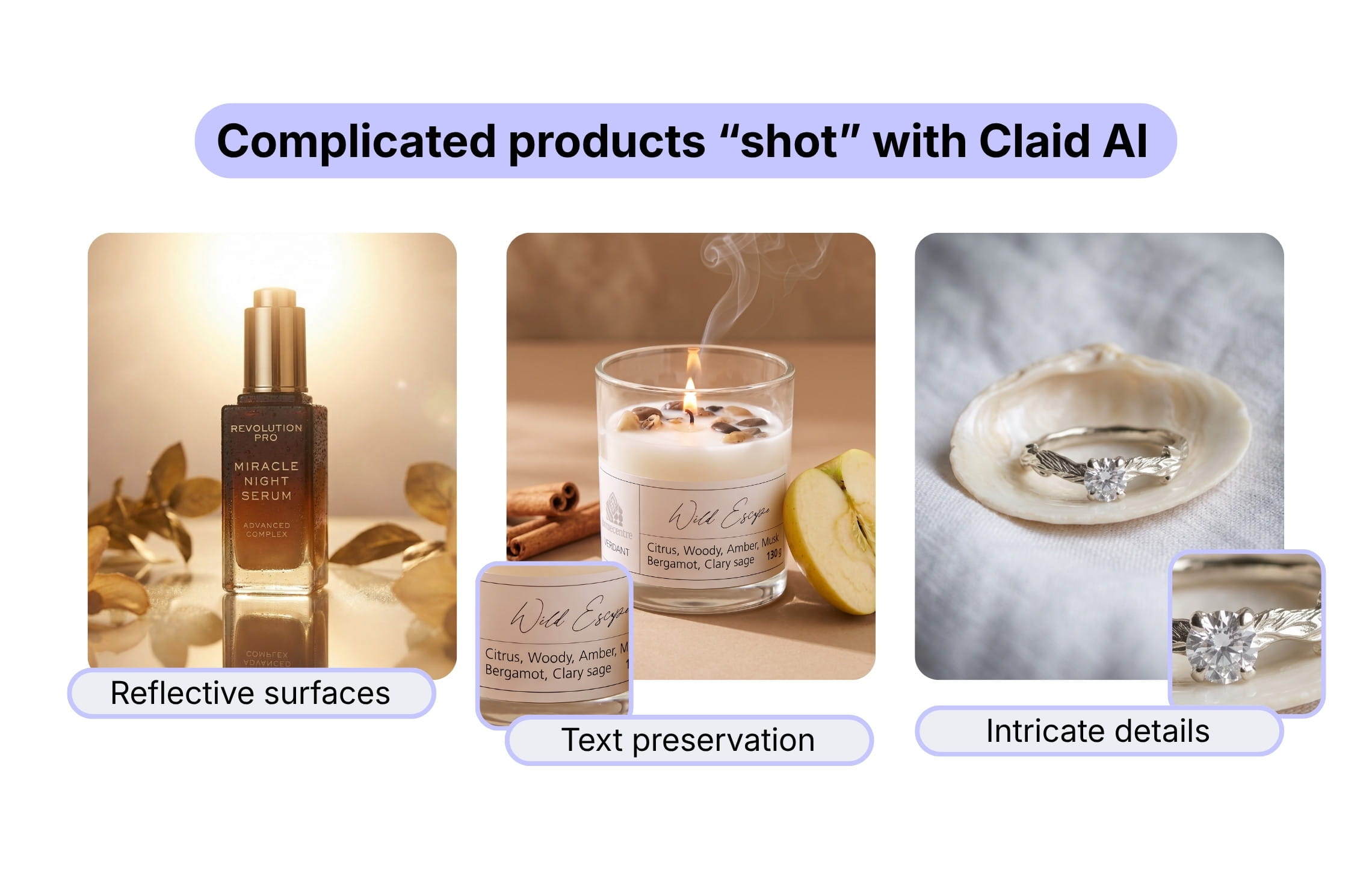
Matte boxes and simple apparel are faster to light than watches, glass, chrome, jewelry, or reflective cosmetics packaging. Transparent and highly reflective products often need specialized lighting, compositing, and detailed cleanup.
AI has a similar constraint. Fine labels, exact geometry, texture, reflections, and small product details require closer review. For accuracy-critical products, budget for more generations and manual retouching.
“Traditional product shoots used to cost us £2,500 to £3,500 a session before AI because handcrafting skin tones, reflections and all the details in the image can take a lot of studio time. Our per-project tool spend is now at approximately £150-200 per month with AI used for our initial batch editing, background separation and colour grading presets.”
Abu Bakar, Digital Marketing Manager, Memory Filming
Number of angles and final images
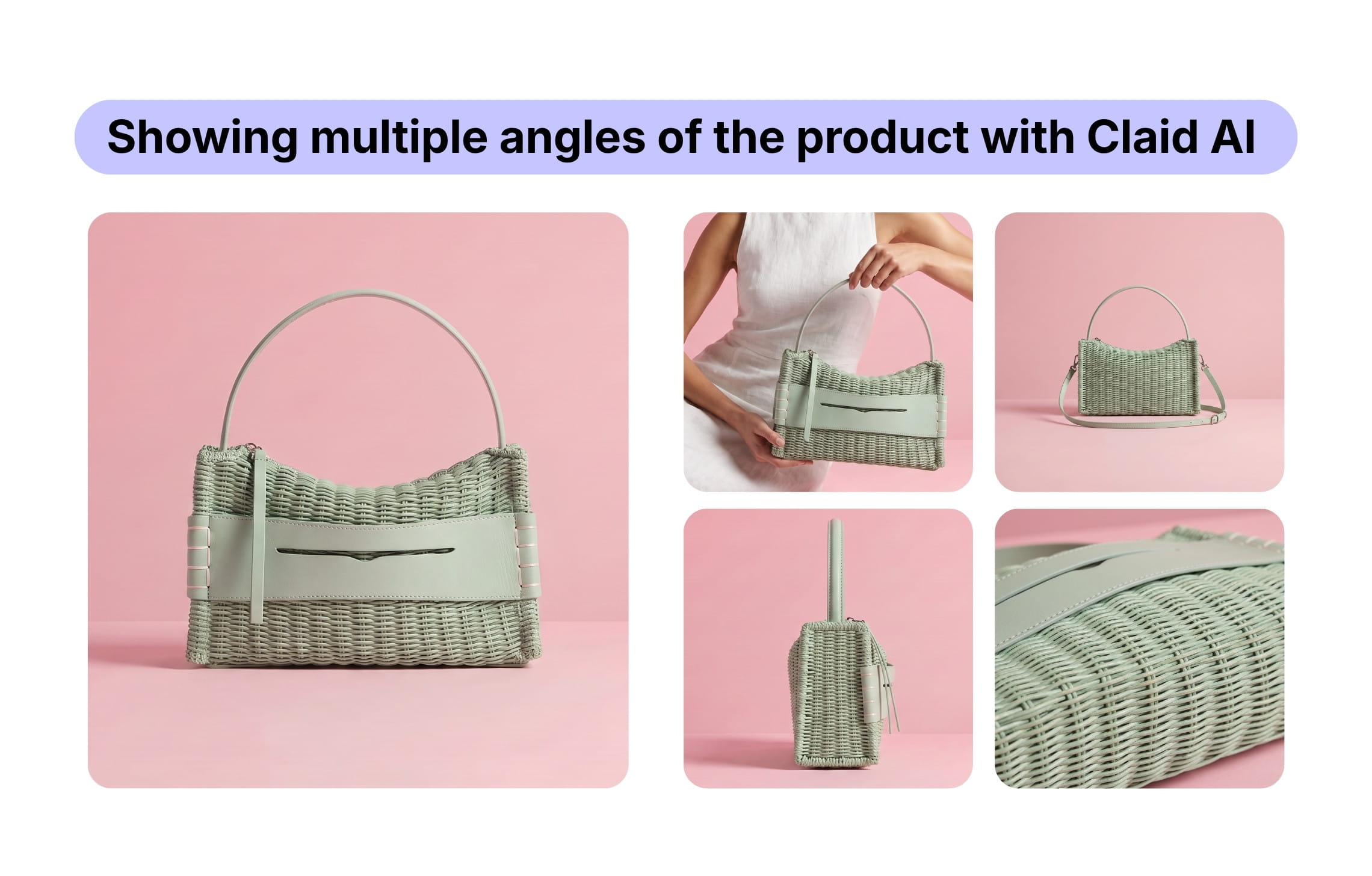
Photographers may quote per SKU, but your real unit is the finished image. A 100-SKU catalog with one angle is a different job from the same catalog with front, back, detail, scale, packaging, and lifestyle images.
Write the shot list before asking for quotes: number of SKUs, all angles, and required scenes. For AI production, add an iteration factor (estimated number of generations and editing operations).
“A $1,500 ad spend with $650 in editing came to $2,150 before background changes or format variations. The AI-edited version plus human editing came to $550, a difference of $1,600 per campaign.”
Cyrus Kennedy, Chairman & Acting CEO, The Ad Firm
Styling, props, and set building
A white sweep is inexpensive and reusable. A lifestyle scene may require surfaces, props, sourcing, set construction, food styling, wardrobe, or location permits, all of which are billed separately.
AI can remove much of that physical production cost. It’s especially useful when you want the same product in seasonal, regional, or campaign-specific settings. You still need a clear visual brief, and someone must check that the generated scene makes sense.
“Traditional studio product photography used to cost us around $1,800 to $2,500 per room scene. Integrating AI-driven pipelines slashed our per-scene visual production cost down to under $85 while completely eliminating the need for physical studio builds.”
Josh Qian, COO and Co-Founder, LINQ Kitchen formerly BestOnlineCabinets
Models and crew
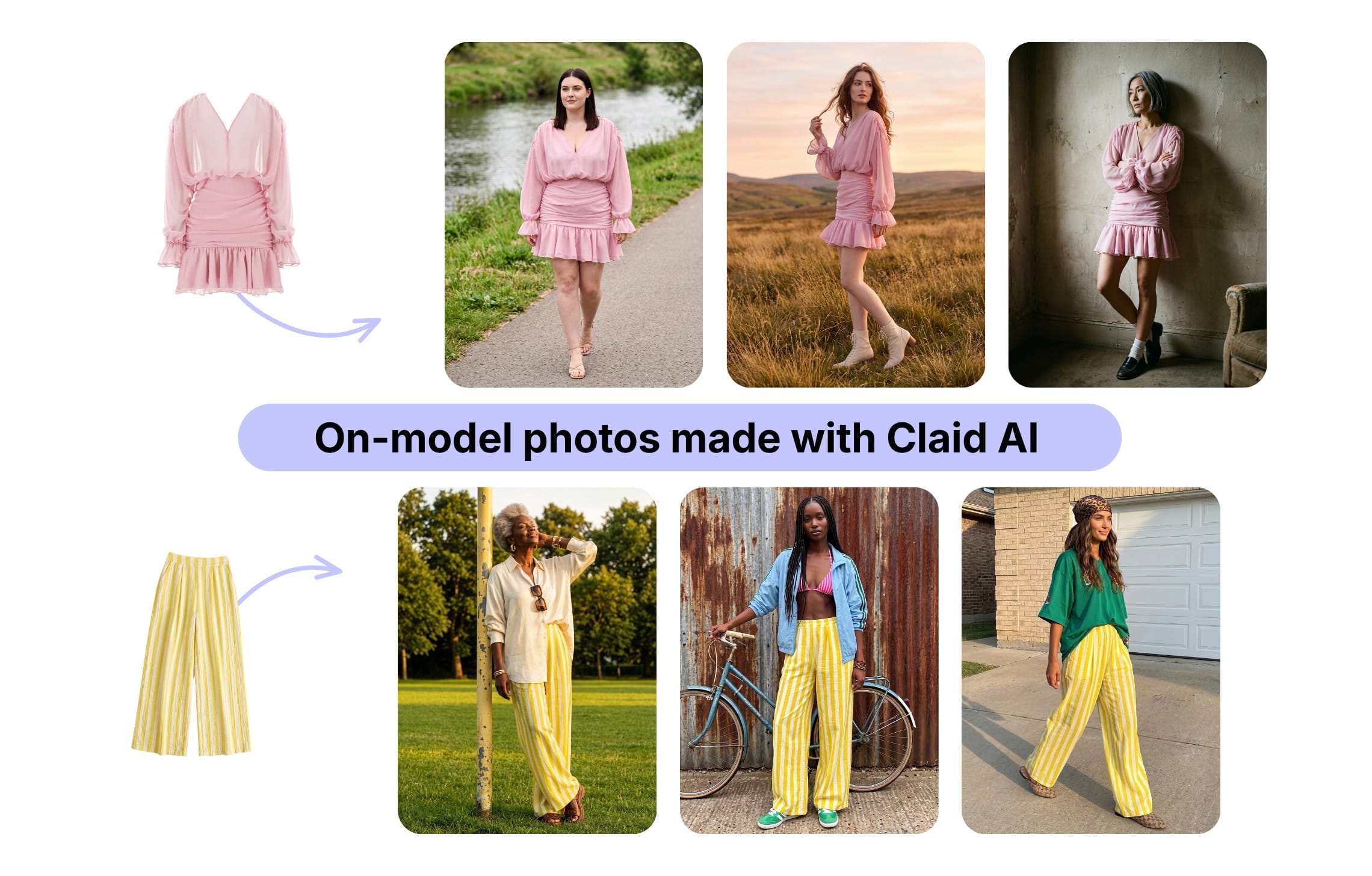
On-model photography may involve a model, photographer, assistant, stylist, hair and makeup, producer, and retoucher. Usage terms for talent can also vary by channel, market, and duration.
For fashion, AI models can make it cheaper to test different looks or expand representation without organizing another shoot. A traditional shoot is still valuable when the person is the campaign, when a specific performance matters, or when you need indisputable documentary authenticity.
“A full product shoot used to run us around $1,200 to $1,800 by the time we counted the photographer, studio time, and styling. Editing added another $15 to $30 per image, and a single product could eat two to three days from setup to final files. After bringing in AI tools, we spend roughly $50 to $100 a month, and most of that work now happens in an afternoon.”
Retouching and revisions
Basic color and exposure correction may be included. Detailed surface cleanup, reflection control, wrinkle removal, label repair, compositing, and background reconstruction may be extra. Basic retouching is priced around $45 per image and advanced work at $100+.
Ask how many revision rounds are included and what counts as a revision. With AI photography services, ask who checks labels, textures, geometry, shadows, and scene logic, and how many revisions the quote covers.
“With the adoption of AI, the editing spend went from roughly $600 per drop to under $80 in tool subscriptions, and turnaround dropped from weeks to about a day and a half.”
Rick Elmore, CEO, Simply Noted
Shipping, storage, and logistics
Traditional ecommerce studios usually need the physical product. Your budget may include inbound and return shipping, insurance, storage, sample tracking, customs, and replacement products if something is damaged.
AI production can start from a source image, which makes it useful for geographically distributed catalogs and supplier-provided assets. But if the source image is poor, you may still need to capture a cleaner reference first.
“Traditional studio photography previously cost our business between $4,000 and $6,000 per product collection, including studio rental, sample shipping, photographer fees, and post production retouching. After integrating AI tools into our workflow, our direct expenditure dropped to roughly $300 to $500 per collection. Overall, this technology has reduced our visual production costs by more than 85%, saving us approximately $5,000 each year.”
RUTAO XU, Founder & COO, TAOAPEX LTD
Usage rights and licensing
The shoot fee might not include every use. Confirm whether you can use the final images on your store, marketplaces, organic social, paid ads, email, print, out-of-home campaigns, and in every country where you sell. Also ask whether the license expires.
With AI tools, review the provider’s commercial-use terms and your marketplace or retailer’s content rules.
“We argued about it at first, but using AI for quick changes has really worked. I’d say we’ve saved about 80% in time and money with no drop in image quality.”
Ben Hathaway, CEO, Wedding Rings UK
Turnaround and reshoots
A conventional studio may deliver in several business days. Ecommerce studio timelines commonly sit around 5 to 7 days, while rush delivery can add a premium.
By contrast, AI can produce options in seconds, but approval can still take time. The practical speed advantage comes from skipping product shipping, crew scheduling, set construction, and reshoots for every new background.
“We used to spend 10-15 days on product photography. Studio time, editing, logistics—it all added up. Now AI tools cut it down to 2-3 days per catalog.”
How much does AI product photography really cost?
To take everything into account, consider these separate costs:
- Input creation. You need at least one clear, accurate photo or render of the product.
- Generation. The price depends on the tool, feature type, and resolution. In Claid, you can generate product photos for as little as $1-3 per finished asset.
- Production and QA. Someone defines the brief, generates options, selects outputs, checks labels and product details, retouches exceptions, exports formats, and routes files for approval. With AI tools, you’ll need to account for internal labor costs. With custom AI photography services, this work is usually part of the project scope and included in the quote.
When should you still hire a product photographer?
Considering everything we’ve reviewed, here are the major scenarios when a traditional shoot is a better choice or a necessary step:
- You don’t have an accurate source image of a new physical product.
- Exact color, material, transparency, reflection, or geometry is legally or commercially critical.
- You need macro details, 360-degree spins, packaging documentation, or multiple real angles.
- A named model, celebrity, founder, athlete, or real customer is central to the campaign.
- You need documentary proof of the product in a real place or real event.
- The campaign depends on highly specific human performance, food behavior, liquid motion, or practical effects.
- Your marketplace, retailer, or internal policy restricts generated content.
AI is usually strongest when you already have an accurate product reference and need to turn it into more useful content: new backgrounds, lifestyle scenes, ad variants, localized creative, seasonal campaigns, on-model fashion images, or a steady catalog pipeline.
Many brands will get the best economics from a hybrid approach. Use a controlled shoot to create accurate master assets, then use AI to extend those assets across scenes, formats, markets, and campaigns.
Get your next product photos faster and cheaper
At Claid, we turn existing assets into diverse product visuals without the cost and complexity of another physical shoot. Reach out to us to discuss a custom AI product photography service to build a repeatable workflow for a large catalog or niche-specific needs.
Product photography pricing FAQ
How much does product photography cost per image?
A standard white-background packshot commonly costs $25-$75 per finished image. Styled lifestyle photography often costs $150-$500+ per image. Complex materials, models, sets, licensing, and advanced retouching can raise the price. With AI, this price drops around 90%, but you’ll still need to account for the first product capture and the cost of revisions and editing.
How much does AI product photography cost with Claid?
Likely self-serve spend can be around $8-$15 for 10 finished 2K photos (while 10 single-pass generations can cost you as little as $3, these estimates include multiple tries and editing tools for polishing your results). If you’re looking for a custom AI photography pipeline, the pricing depends on your products, catalog volume, and quality requirements. Talk to our team to get an estimate.
Is AI product photography cheaper than a photoshoot?
Yes, if you already have accurate source images and need multiple backgrounds, formats, or campaign variations. The savings might reach 80-90%. However, the comparison becomes less favorable if the product still needs to be photographed from all angles for the first time, outputs need extensive correction, or your team spends significant time reviewing and fixing them.
How can I reduce product photography costs?
Finalize the shot list before production, batch similar products, limit unnecessary angles, avoid rush delivery, confirm licensing in advance, and create accurate master images that can be reused. A hybrid workflow can reserve traditional photography for source assets and hero creative, then use AI for variants and ongoing content.
Need custom photo and video production?
Claid can build an AI pipeline around your requirements and brand aesthetic.


Claid.ai
September 28, 2026