Tech
6 best product photography services in 2026


There are three ways to get professional product photography.
The first is a physical studio service. You ship in your products or arrange an on-location shoot, and a production team handles the photography, lighting, styling, and retouching.
The second is an AI-native photography service. Instead of photographing every scene, the provider works from your existing product images to create new backgrounds, lifestyle settings, on-model photos, and campaign variations.
The third is a hybrid option that combines physical photography with AI generation or AI-assisted post-production.
In this guide, we’ll compare 6 product photography services across these different models. The article covers what each provider delivers, how its pricing works, and where its limitations are. The goal is not to identify one universal winner but to help you choose the right production model and shortlist the services built for it.
Need custom photo and video production?
Claid can build an AI pipeline around your requirements and brand aesthetic.
The best product photography services at a glance
Before exploring each service in detail, here’s an overview of where our picks stand:
| Service | Best for | Service model | Published pricing | Main limitation |
|---|---|---|---|---|
| Claid AI | Producing lifestyle, campaign, and on-model images at scale from existing product photos | AI-native managed production | Custom pricing dependent on volume | Requires usable source images and quality control |
| Soona | Fast, collaborative ecommerce shoots | Ship-in studio photography and video | $149 studio pass and $39 per selected photo | Models, styling, advanced edits, and upgrades cost extra |
| Squareshot | Premium, art-directed studio photography | Ship-in studio and hybrid production | Product shoots from $50 per image or $750 for 2 hours | Higher starting spend than editing or AI-native production |
| Snappr | Local and multi-location shoots | On-demand photographer network and hybrid production | Custom quote per shoot, plus applicable service fees | Creative consistency can depend on the photographer and brief |
| Pixelz | High-volume ecommerce retouching | Human-assisted, AI-enabled post-production | Professional plan: $95 per month plus images from $0.95 each | Primarily improves existing shots rather than creating new compositions |
| Pixc | Basic ecommerce cleanup without a subscription | AI-powered editing service | Credit packs, with basic editing around $2 per image | Limited creative and advanced retouching scope |
Pricing was checked in August 2026 and may change. Product preparation, shipping, models, styling, props, revisions, advanced retouching, and rush delivery can affect the final cost.
1. Claid, AI-native product image production
Claid provides AI product photography services for brands of different sizes, on top of its web app and self-served APIs. With its service, you can turn existing plain images into lifestyle scenes, on-model fashion assets, campaign variations, catalog variations, and product videos.
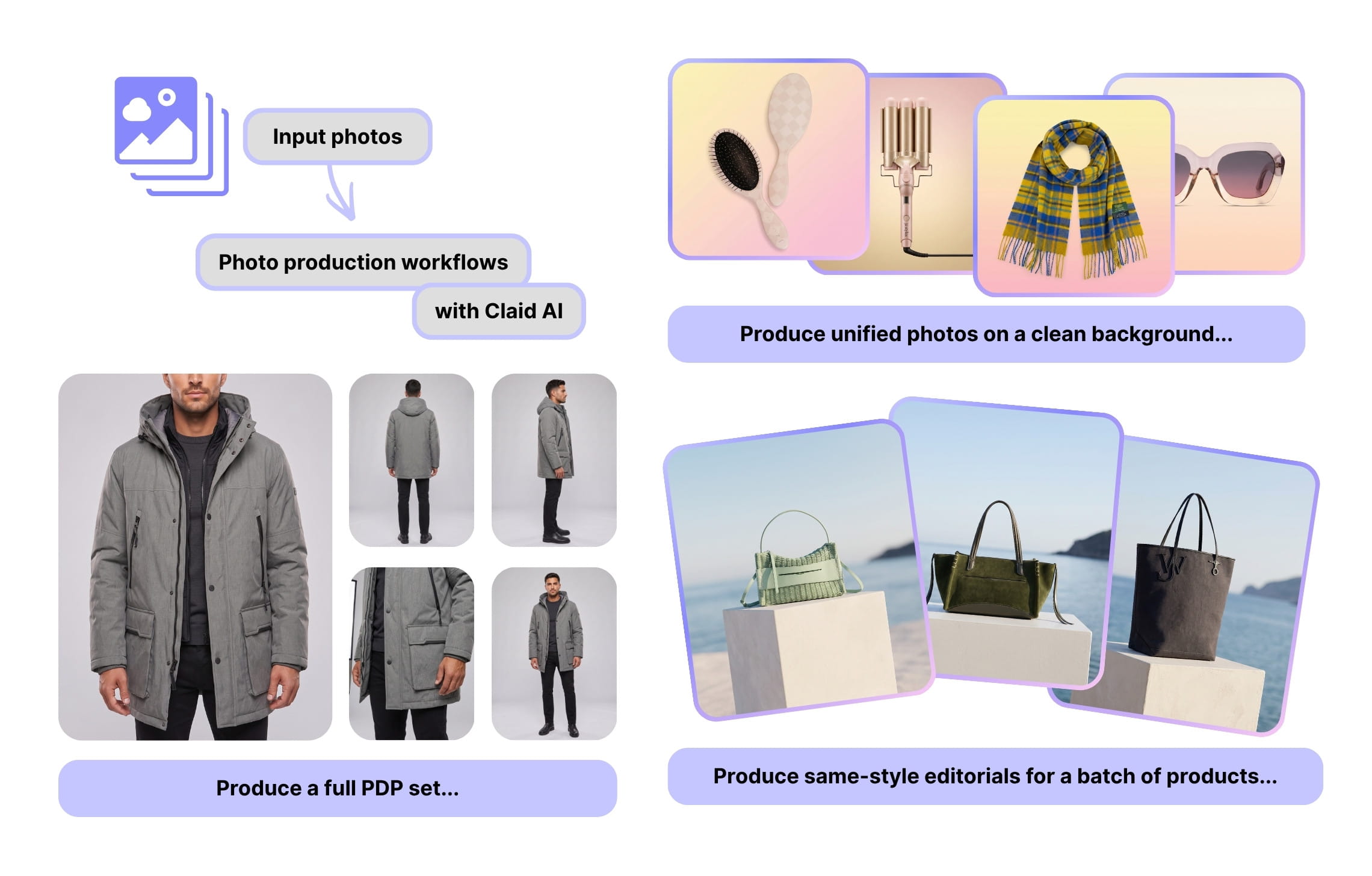
You can explore Claid’s functionality on its self-serve platform or by integrating API internally. But for custom product photography at scale, Claid offers a dedicated creative and engineering team that builds a production workflow around your visual identity, output specifications, and quality standards.
Claid is relevant when a company needs to create many new assets from a smaller set of high-quality product photos. Examples include producing regional campaign variations, turning fashion flatlays into diverse on-model images, or standardizing seller images across a marketplace.
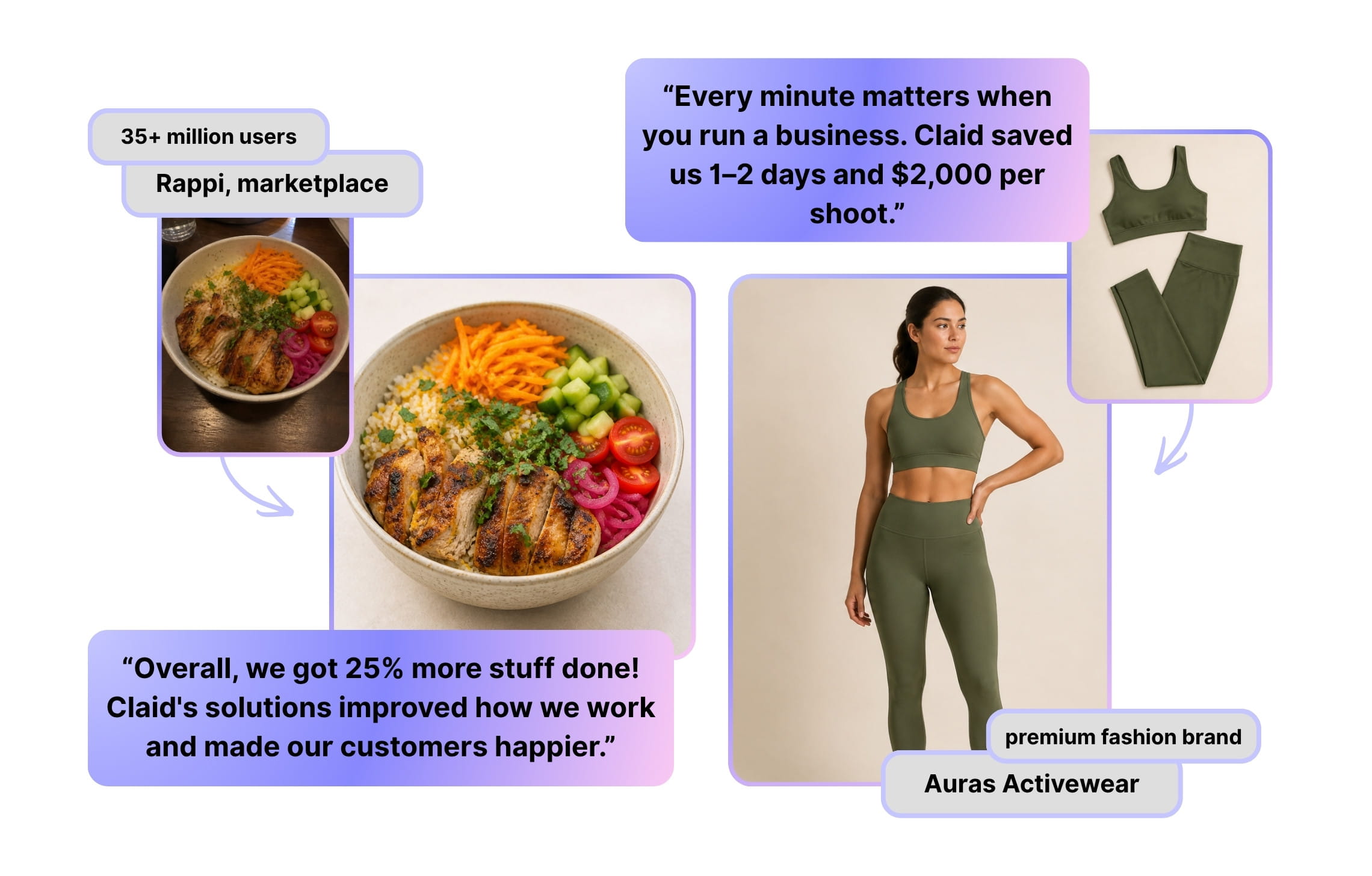
For example, Auras Activewear used Claid’s AI custom pipelines to turn flatlay garment photos into on-model images, saving up to $2,000 per collection and removing 1–2 full days from its production process. At marketplace scale, Rappi used Claid to automate the enhancement and standardization of restaurant images, reducing image-editing time by 42% and shortening restaurant onboarding from 9 to 1.2 days.
The service still depends on the quality of its source material. Claid isn’t the right starting point if a product hasn’t been photographed clearly. AI-generated images can also misrepresent shape, texture, fit, text, or small construction details: make sure to provide your highest-resolution images that show products from different angles.
Products with complex reflections, transparent materials, intricate jewelry details, strict color requirements, or regulated claims may still require conventional photography. If an exact representation of fit or construction is central to the purchase decision, every generated image should be reviewed carefully.
Primary use case: Creating lifestyle scenes, on-model fashion images, campaign variations, and product videos from existing photos.
What you need to provide: Clear source images, visual references or brand guidelines, output requirements, and approval criteria.
Pricing: Custom-priced solutions. A credit-based platform (with 50 free credits) is available for teams that want to evaluate the output before discussing a larger engagement.
Main limitation: Generative production can alter product details, so outputs need a defined quality-control process.
2. Soona, ship-in studio photography and video
Soona provides physical product photography and video through studios in Denver, Austin, and Minneapolis. Customers ship their products to a studio, plan the shoot through Soona’s platform, collaborate with a creative, and purchase the finished assets they want.
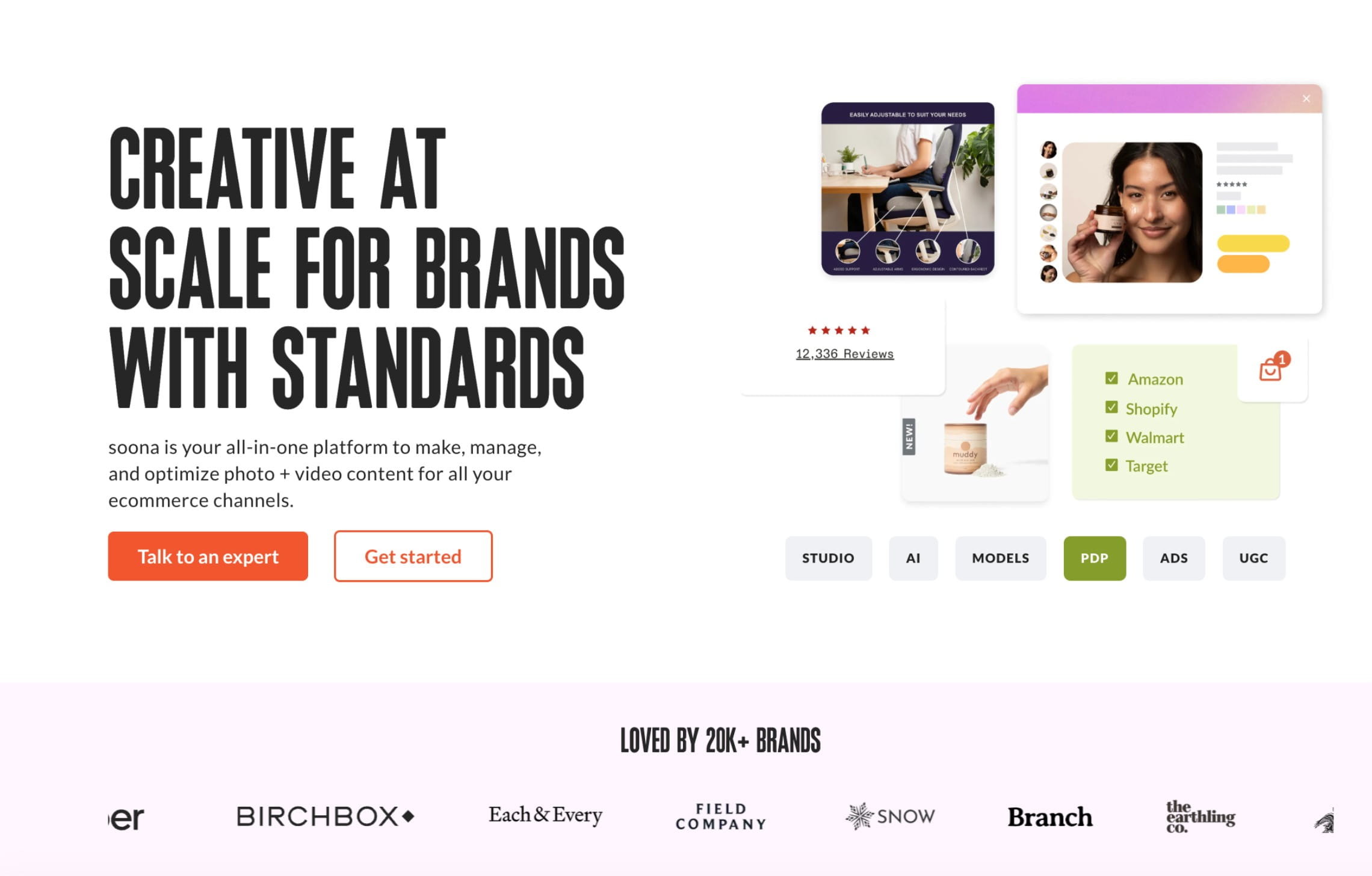
Their professional product photography services are structured for brands that need assets without assembling their own photographer, studio, and production crew. Live collaboration allows a founder, marketer, or creative lead to respond to the shoot while it’s happening.
Soona’s published pricing lists photos at $39 each and video clips at $93. Memberships can provide faster delivery or lower prices on some add-ons, while enterprise packages add dedicated account management.
Note that the base image price isn’t the complete project cost. Models, styling, premium editing, video edits, and other production upgrades are separate or depend on the selected membership. A straightforward tabletop shoot may stay close to the base rate, while a model-led or heavily styled campaign will cost more.
Primary use case: Producing ecommerce photography and video through a remote physical studio.
What you need to provide: The physical products, a shot list, references, brand requirements, and shipping instructions.
Pricing: $149 Studio Pass per booking, $39 per selected photo, and $93 per selected video clip. Membership and enterprise plans are available.
Main limitation: The final price can rise when the project requires models, styling, advanced editing, or production upgrades.
3. Squareshot, art-directed physical product photography
Squareshot is a studio-led production service for brands that want polished physical product photography. It offers product shoots, model shoots, visual concept development, retouching, and AI-generated visuals.
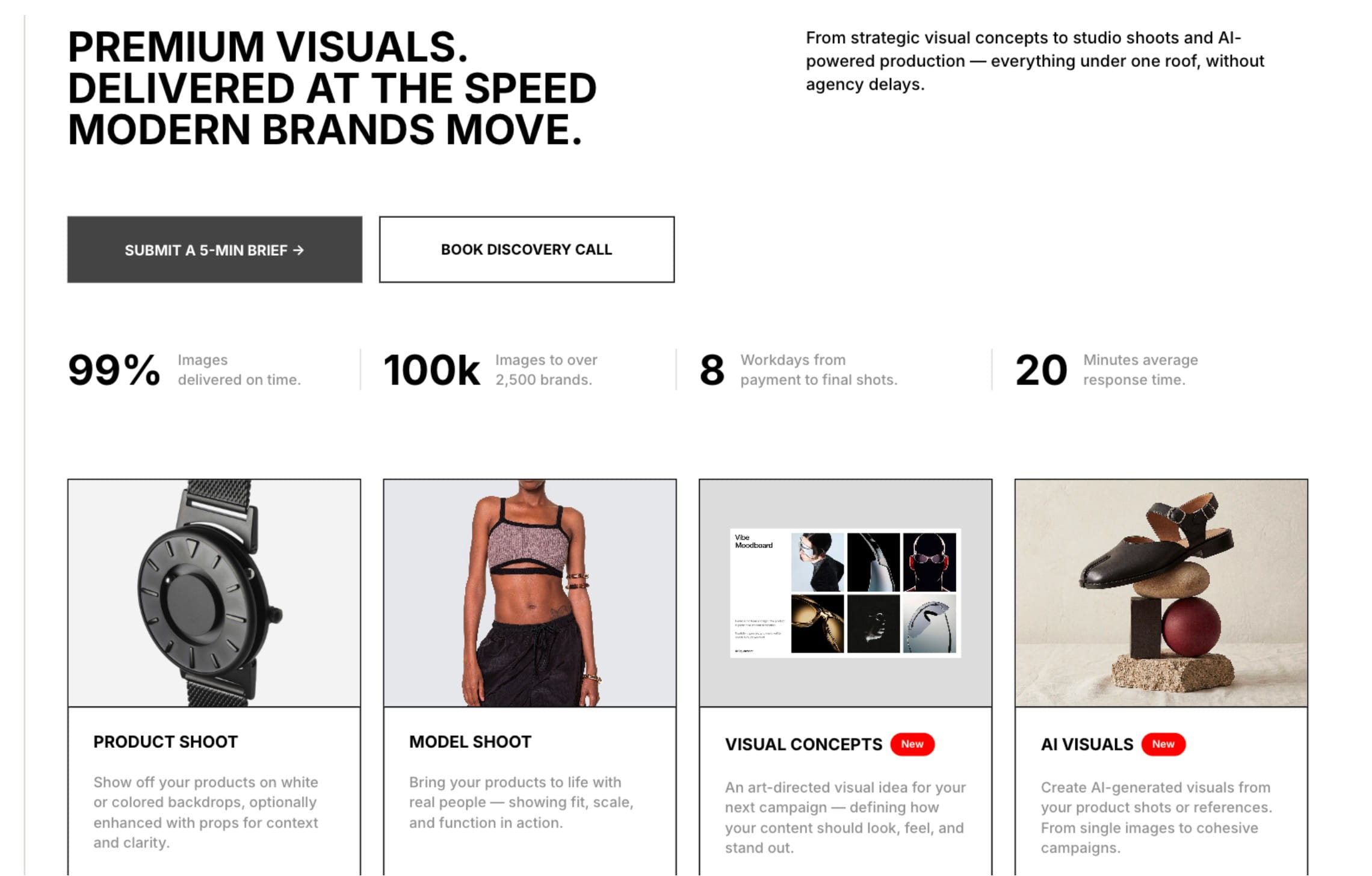
The company can handle clean ecommerce photography as well as more developed campaign work. Its production options may include photographers, producers, stylists, models, studio assistants, and concept development, depending on the project.
Squareshot’s published pricing starts at $50 per image or $750 for a two-hour product shoot. Model photography starts at $95 per image or $2,950 for four hours. AI visuals start at $95 per image.
This structure is relevant to beauty, fashion, accessories, and other consumer brands that need careful lighting, art direction, and a consistent visual treatment. Working with one production company can also reduce the need to source and coordinate several specialists independently.
The service may be more extensive than a seller needs for basic catalog cleanup or scaling ecommerce visuals. If accurate packshots already exist and the main need is a large number of new lifestyle settings or campaign variations, AI-native production may offer a different cost and turnaround profile.
Primary use case: Producing art-directed catalog images, model photography, and campaign assets in a physical studio.
What you need to provide: Physical products, a creative brief, shot requirements, references, and any brand or usage guidelines.
Pricing: Product photography starts at $50 per image or $750 for a two-hour shoot. Model shoots and more involved productions cost more.
Main limitation: The production model has a higher starting spend than editing-only services and may be unnecessary for routine catalog work.
4. Snappr, on-location and distributed photography
Snappr coordinates shoots through a network of photographers rather than operating as one central ship-in studio. Customers enter their project details, select an available professional, book the session, and receive edited images through the platform.
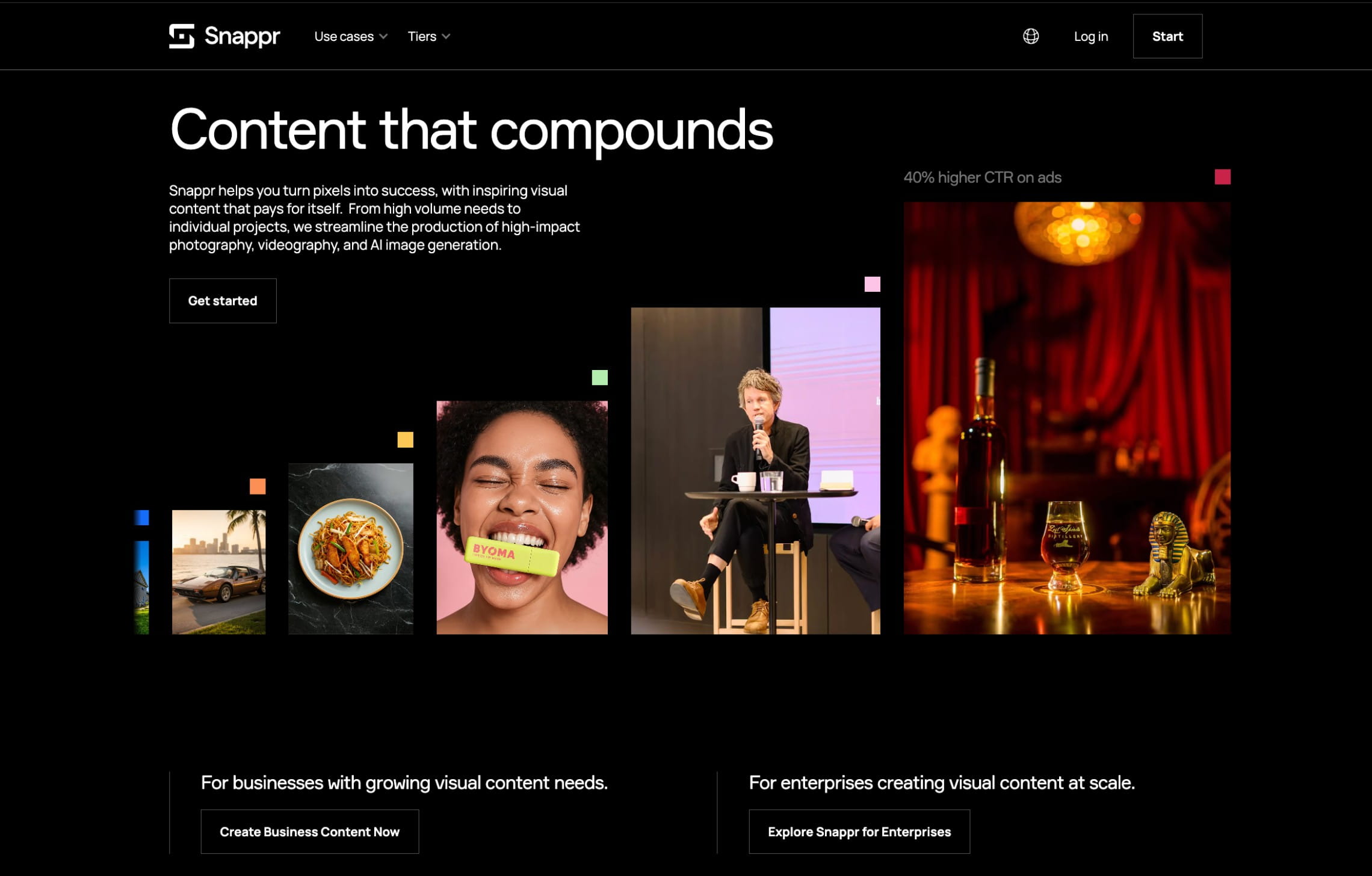
This model is relevant when products are large, installed, perishable, difficult to ship, or already distributed across different locations. It can also support companies that need a similar photography program repeated in several cities. Plus, Snappr combines conventional photography with managed AI image generation.
Photography prices depend on the shoot type, duration, product size, number of products, and required angles. Pay-as-you-go bookings carry a 15% service fee, while Pro and Enterprise plans reduce or remove that fee. The service claims that standard edited galleries are delivered within 48 hours.
The main tradeoff comes from the photographer-network model. Availability, portfolio fit, and the quality of the creative brief all affect the result. A dedicated studio team may provide more continuity for a tightly art-directed campaign. Enterprise customers can address some of this through centralized editing, creative guidelines, workflow controls, and account management.
Primary use case: Organizing product photography at the customer’s location or across multiple locations.
What you need to provide: Access to the product and location, a detailed brief, shot requirements, and any necessary styling or preparation.
Pricing: Custom quote per shoot. Pay-as-you-go adds a 15% service fee.
Main limitation: Creative consistency can depend on photographer selection, local availability, and the strength of the production brief.
5. Pixelz, high-volume ecommerce post-production
Pixelz is primarily a post-production service. Customers send product images that have already been photographed, and Pixelz prepares them for ecommerce use.
Its professional product photography services include background removal, alignment, cropping, shadows, invisible mannequin editing, color matching, and category-specific retouching. Pixelz combines automated processing with specialist editors to apply repeatable image specifications across large catalogs.

This type of photography service is relevant to fashion brands, marketplaces, and retailers that already have image creation covered. Pixelz can take over the editing stage without requiring the photography team to change how it captures products.
Pixelz’s Professional plan costs $95 per month, with editing starting at $0.95 per image. It includes next-morning delivery and a listed capacity of 200 images per day. Enterprise pricing is customized for higher volumes and more complex workflows. Note that advanced retouching, color matching, multiple output formats, and other additions can increase the final price.
Pixelz also offers AI-generated assets and campaign services. However, its clearest distinction in this comparison remains structured, high-volume post-production for existing photos.
Pixelz and Claid therefore start with similar inputs but produce different core outputs. Pixelz generally finishes and standardizes an existing shot, while Claid uses the source image to create new scenes and compositions.
Primary use case: Retouching and standardizing large volumes of existing product photos.
What you need to provide: Completed product photography, editing specifications, output formats, and reference images where necessary.
Pricing: The Professional plan costs $95 per month, plus editing from $0.95 per image. Enterprise pricing is custom.
Main limitation: Its core post-production service improves existing shots rather than creating an entirely new set of compositions.
6. Pixc, Shopify image apps and ecommerce editing services
Pixc offers product photo editing services with a straightforward buying model for smaller or less predictable image volumes. Customers purchase credits, upload product images, select their ecommerce requirements, and review the results. There is no subscription, and purchased credits remain valid for one year.
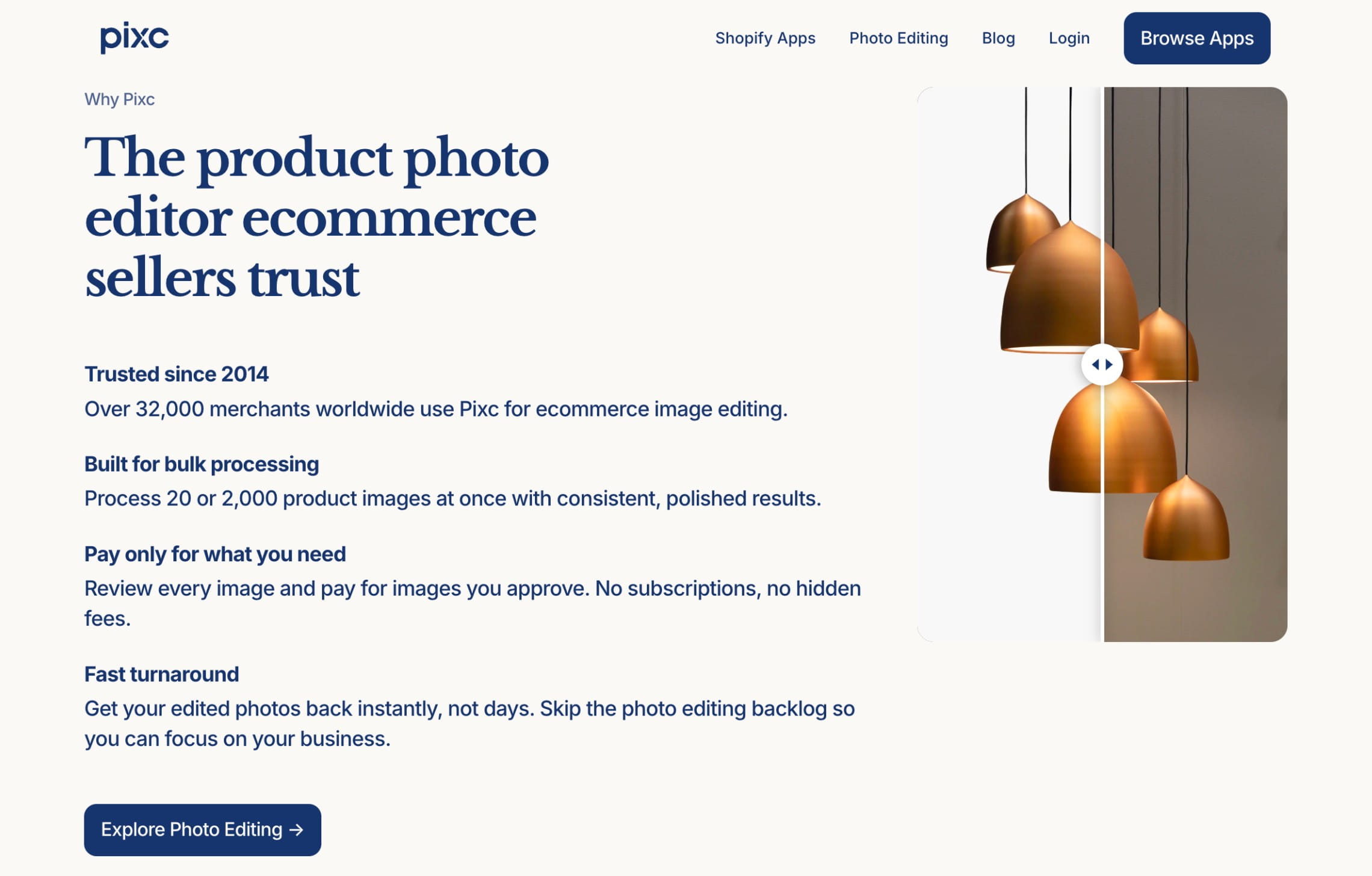
The service handles background removal, cropping, resizing, shadows, reflections, color correction, and image enhancement. It is designed around common requirements for Shopify, marketplace catalogs, and wholesale portals.
For merchants working directly in Shopify, Pixc also offers apps for several recurring image and catalog tasks: replacing product backgrounds and standardizing image dimensions, resizing and outpainting images, creating AI lifestyle photos, and organizing collection pages through visual merchandising.
Pixc’s offer different packages: 10 basic images for $20, 50 for $100, and 1,000 for $2,000. Customers review images before paying for approved work and can request revisions when necessary.
Pixc is relevant to sellers that can take acceptable source photos but need them cleaned up and made visually consistent. The absence of a monthly subscription also suits businesses with occasional batches instead of a continuous production schedule.
Primary use case: Handling routine ecommerce image cleanup for intermittent or moderate image volumes.
What you need to provide: Existing product photos and the required background, dimensions, crop, file format, and marketplace specifications.
Pricing: Credit packs with no subscription. Published basic packages work out to approximately $2 per image.
Main limitation: The service has a narrower scope than advanced retouching, physical photography, or generative production.
How to choose a product photography service for your needs
Start with the assets you already have and the images you need to produce. Ask yourself the following questions.
1. Do you have accurate source photos?
If not, begin with physical capture through Soona, Squareshot, or Snappr.
If clear and accurate product photos already exist, Claid, Pixelz, or Pixc may complete the next stage without another shoot.
2. Where should the physical shoot happen?
Choose a ship-in service such as Soona or Squareshot when the products can be sent to a studio.
Choose Snappr when the product needs to be photographed at its current location or across several locations.
3. Do you need new compositions or cleaner existing images?
Claid creates new settings, model images, and campaign variations from source photography.
Pixelz and Pixc primarily retouch, standardize, and reformat images that already exist.
4. How exact must every detail be?
Use conventional photography for technical details, complex materials, precise color, regulated claims, or images that must document the physical product exactly.
Use AI product photography services for new contexts, creative experimentation, and campaign variation. Establish an approval process for product shape, text, logos, texture, scale, and fit.
5. What is included in the quote?
Compare the complete scope of each quote, including product shipping and returns, preparation, props, set construction, models, styling, retouching, revisions, usage rights, file requirements, rush delivery, and any platform or service fees.
The lowest headline price isn’t always the lowest final project cost.
6. Can the provider repeat the required look?
Run a pilot using several representative products, including the most difficult SKU in the catalog.
Evaluate consistency across the complete set. One strong sample image doesn’t demonstrate that a provider can deliver the same quality across different colors, materials, shapes, and product categories.
Which service model fits your project?
- Claid: New scenes, model images, and campaign variations created from existing product photos
- Soona: Physical ecommerce photography and video through a ship-in studio
- Squareshot: Art-directed physical production for products, models, and campaigns
- Snappr: On-location photography coordinated through a distributed photographer network
- Pixelz: High-volume retouching and standardization after photography
- Pixc: Routine ecommerce editing for intermittent image batches
These ecommerce product photography services can also form different stages of one production workflow.
A physical studio can create accurate hero images and core packshots. A post-production service can make the catalog consistent. An AI product photography service can then extend those assets into seasonal scenes, regional campaigns, new formats, and on-model variations.
Need custom workflows for professional product photography?
If you already have high-quality product images but need more campaign assets, standardized catalog visuals, or content for different markets, Claid can build and run a production workflow around your requirements. Let’s discuss your product categories, image volumes, quality standards, review process, and delivery formats.
FAQ
What does a product photography service include?
A physical studio service may include photography, lighting, product preparation, props, retouching, and asset delivery. Models, styling, set construction, advanced retouching, shipping, and rush delivery are often priced separately.
Editing and AI-native photography services require high-quality source product images. Editing services improve existing images, while AI-native services can use them to create new compositions.
How much do product photography services cost?
Basic post-production can start near $1 to $2 per image. Ship-in studio photography commonly starts around $39 to $50 per selected image before add-ons. On-location shoots, art-directed campaigns, and managed AI-native production are usually quoted according to scope, volume, and complexity.
When comparing providers, calculate the complete production cost rather than comparing only the starting per-image rate.
How should a product photography service handle quality control?
A physical studio should check focus, lighting, color accuracy, required angles, styling, and product condition before the set is taken down. A post-production provider should compare each file with the agreed editing and export specifications. An AI-native service should also review product shape, texture, labels, proportions, realism, and consistency across generated images.
At Claid, quality control is configured around the customer’s products, brand rules, and publishing requirements. For managed fashion production, the customer first reviews the proposed models, styling, scenes, lighting, and sample compositions. Claid then reviews the complete set for product accuracy, model consistency, realism, composition, and alignment with the approved direction. Images that don’t meet the agreed standard are revised or regenerated before delivery. Custom workflows can also flag inputs or outputs that need additional review before publishing.
How do revisions work with these product photography services?
Revision policies differ by provider and may change over time. Make sure to check them when choosing the best product photography service for your needs.
- For Claid’s managed production, images that don’t meet the approved quality standard are revised or regenerated before delivery. You approve the creative direction before full production, and then all outputs are checked for product accuracy, consistency, realism, composition, and brand fit.
- Soona includes one complimentary touch-up with each purchased photo for Studio Pass and Basic customers. Standard and Enterprise customers receive premium edits with the initial order, but additional variants or revisions cost $9 or more per image. Re-edits are available for all edited content, with extra charges applied when the request requires more advanced work.
- Squareshot gives customers 10 calendar days after receiving the approval gallery to request edits. Revisions may be free when they correct the delivered work or paid when they change the agreed direction. Requests made after the approval window are paid, and new angles, styling, or compositions outside the original shot list are treated as new deliverables.
- Snappr doesn’t publish a fixed number of revision rounds for standard photography bookings. Instead, its quality guarantee may result in additional editing, a reshoot, or a refund when the delivered work doesn’t meet the brief. Snappr’s paid AI-image plans include one revision per image.
- Pixelz allows customers to reject images and request free reprocessing when the result doesn’t meet the original specifications. Minor corrections may also be completed without charge. A substantial change or new creative direction is classified as a change request, which can trigger an invoiceable extra round under the customer’s agreement.
- Pixc provides a review period of two days for pay-as-you-go customers and seven days for Pixc Members. Customers can request adjustments or report problems during that period. Pixc also states that an image that isn’t right will be redone at no extra cost.
What should a product photography brief include?
Include the SKU list, required angles and image quantities, visual references, brand guidelines, background and styling requirements, dimensions, file formats, sales channel specifications, retouching expectations, deadline, usage requirements, and the person responsible for approval. Flag products with reflective surfaces, transparent materials, fine text, unusual assembly requirements, or strict color standards.
Should I choose a local photographer or a remote service?
Choose local or on-location photography when the product can’t be shipped, the location is part of the image, or your team needs to attend the shoot.
Choose a remote ship-in service for standardized studio production. Choose an AI-native or editing service when accurate source images already exist and the remaining production can be completed digitally.
Need custom photo and video production?
Claid can build an AI pipeline around your requirements and brand aesthetic.


Claid.ai
September 16, 2026