Tech
4 AI image extenders for product photos in 2026


Outpainting (also called image expansion or uncropping) allows you to seamlessly extend the edges of a photo while preserving realism. This is especially useful for product photography when you need to adapt images to fit different platforms, ad formats, or marketplace requirements.
In this post, we’ll share our experience of testing 10+ AI outpainting tools and highlight how the 4 best of them work.
AI image extenders compared
Note that features might fluctuate over time, as well as regional pricing, usage limits, and model availability.
| Tool | Particularly useful for | Pricing (US-based) |
|---|---|---|
| Claid | Prompt-guided product-photo expansion and connected ecommerce workflows | Free trial; Paid plans from $9/month |
| Adobe Photoshop | Precise canvas expansion, masking, and professional retouching | Free trial; Plans including desktop Photoshop from $19.99/month |
| Photoroom | Seller workflows and batch expansion of product images | Free access; Paid plans from $7.50/month |
| Picsart | Prompt-guided outpainting and repeatable product-ad workflows | Free access; Paid plans from $10.50/month |
Need AI expansion for high-volume catalogs?
Automatically extend backgrounds, fix awkward crops, and adapt product images to new aspect ratios across your catalog. Use the API for a controlled setup, or let our team manage the workflow from input to final assets.
What does an AI image extender actually do?
AI image expansion, also called outpainting or uncropping, generates content beyond a photo’s existing borders. Instead of stretching the product or cutting part of it away, the tool creates additional background.
For ecommerce, that can help you:
- Add negative space beside a product for a headline
- Adapt a square lifestyle image to a landscape layout
- Extend the floor, wall, or backdrop around furniture
- Create more breathing room around a fashion model
- Prepare variations of an existing campaign image
NB! Outpainting can’t recover what the camera never captured. If a handbag handle or garment sleeve is missing from the source, the generated continuation is a guess.
1. Claid.ai, for ecommerce production
Claid.ai combines image expansion with product-photo editing, enhancement, and generation or visuals. You have two options for image outpainting in Claid: with simple settings in a dedicated expansion tool or as a prompt-guided operation in AI Edit. With the latter, you can describe how the scene should continue, where you need more space, and which product details must remain unchanged.
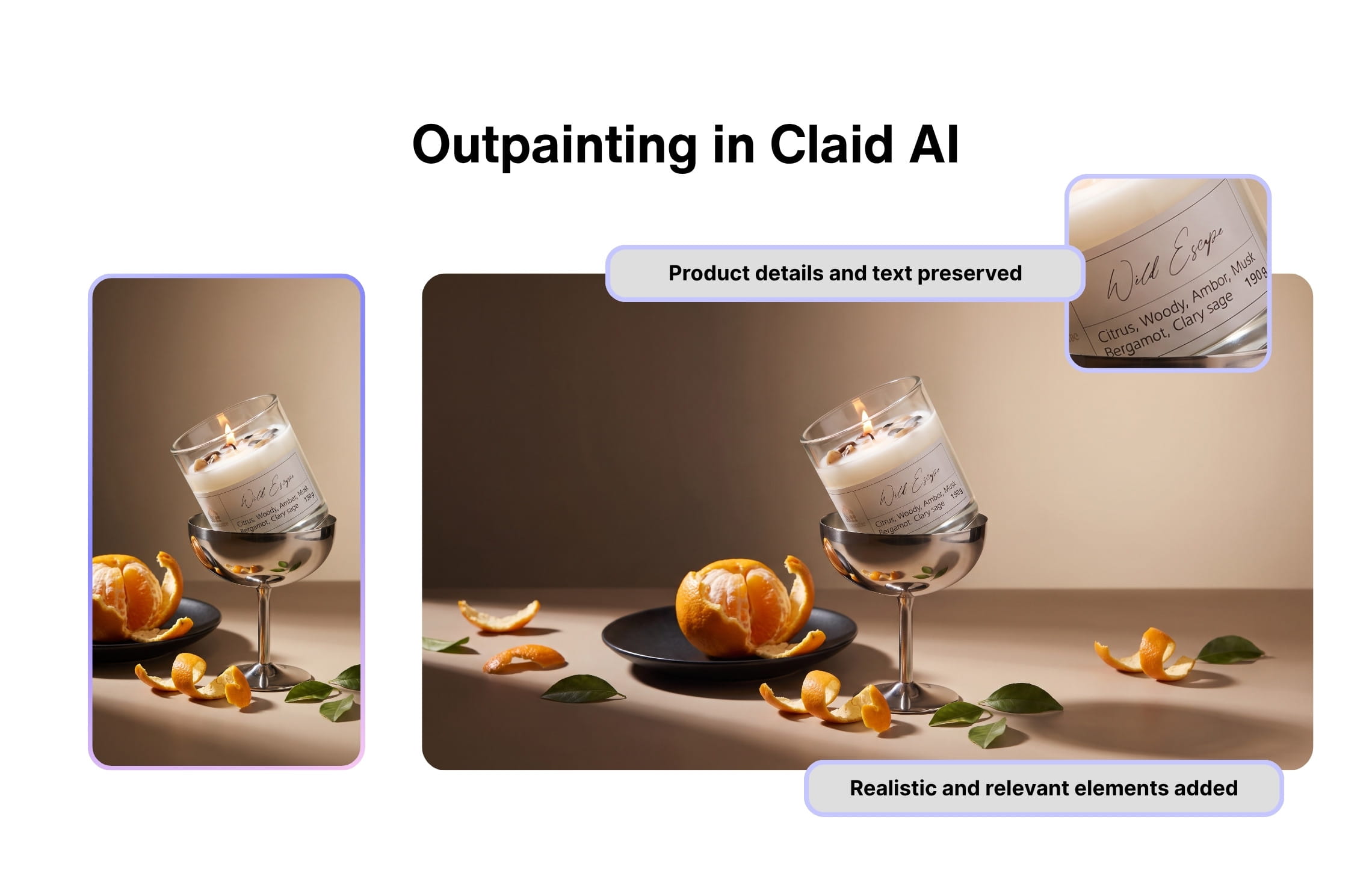
For product and fashion photography, this makes expansion part of preparing an image for its next placement. You might extend a tabletop to accommodate promotional copy, give a tightly framed fashion photograph more breathing room, or adapt a vertical lifestyle image for a horizontal banner. You can then clean up distractions, adjust lighting, and improve resolution without moving to another platform.
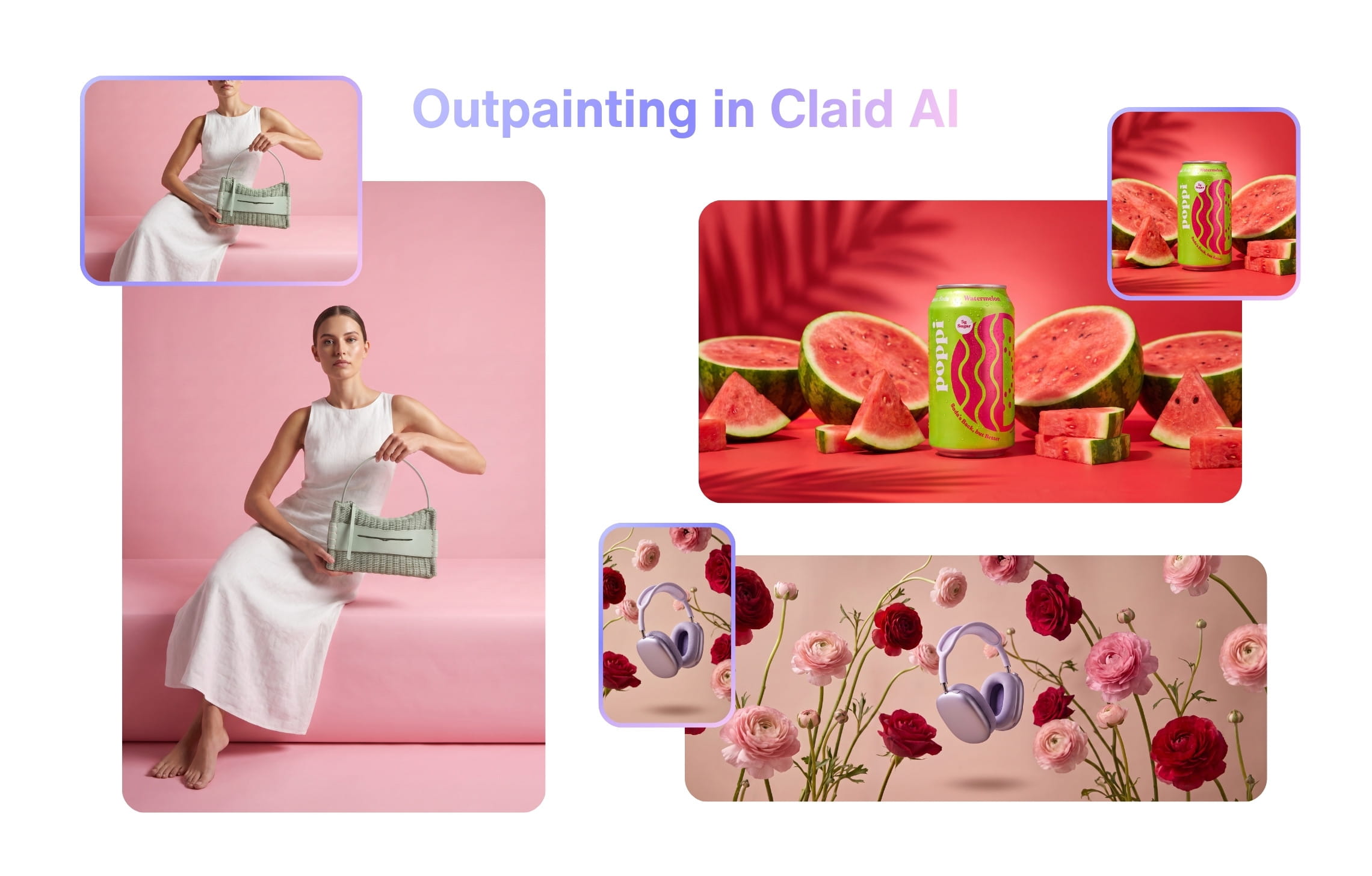
The printing platform Mixam uses Claid to extend artwork into missing bleed margins and enhance low-resolution files. Their workflow helped reduce quality-related complaints by 78%.
For larger catalogs, Claid’s API workflows can connect multiple image-processing operations and support batch processing. A business can also build a custom pipeline that enhances incoming images, expands their surroundings, and prepares the required output sizes.
Teams that prefer to outsource production can use Claid’s AI product photography service. You provide product images, references, and a brief, and the team develops, reviews, and delivers the agreed visuals. That is useful when expansion belongs to a broader project involving product scenes, fashion imagery, and videos.
Key features
- Dedicated resizing and outpainting controls: use preset formats or custom dimensions to adapt images for product pages, marketplace listings, and advertising placements
- Prompt-guided expansion in AI Edit: describe the continuation you need
- Enhancement and lighting adjustments
- Image generation tools to create stunning campaign visuals
- Image-to-video to animate product photos
Pricing
- 50 free web credits, plus 50 free API credits
- Essentials: $15/month, or $9/month with annual billing.
- Pro: $49/month, or $35/month with annual billing.
- Custom pricing for enterprise
Verdict
Claid is a strong candidate when you need to expand product or fashion imagery and continue preparing it for publication. AI Edit is particularly relevant for directed scene extensions, while APIs and managed production support more repeatable work.
2. Adobe Photoshop, for precise expansion and detailed finishing
Photoshop suits teams that need control over both the generated background and the original product. Its advantage is not just access to generative tools: layers, selections, and masks let an editor decide which parts of an image can change.
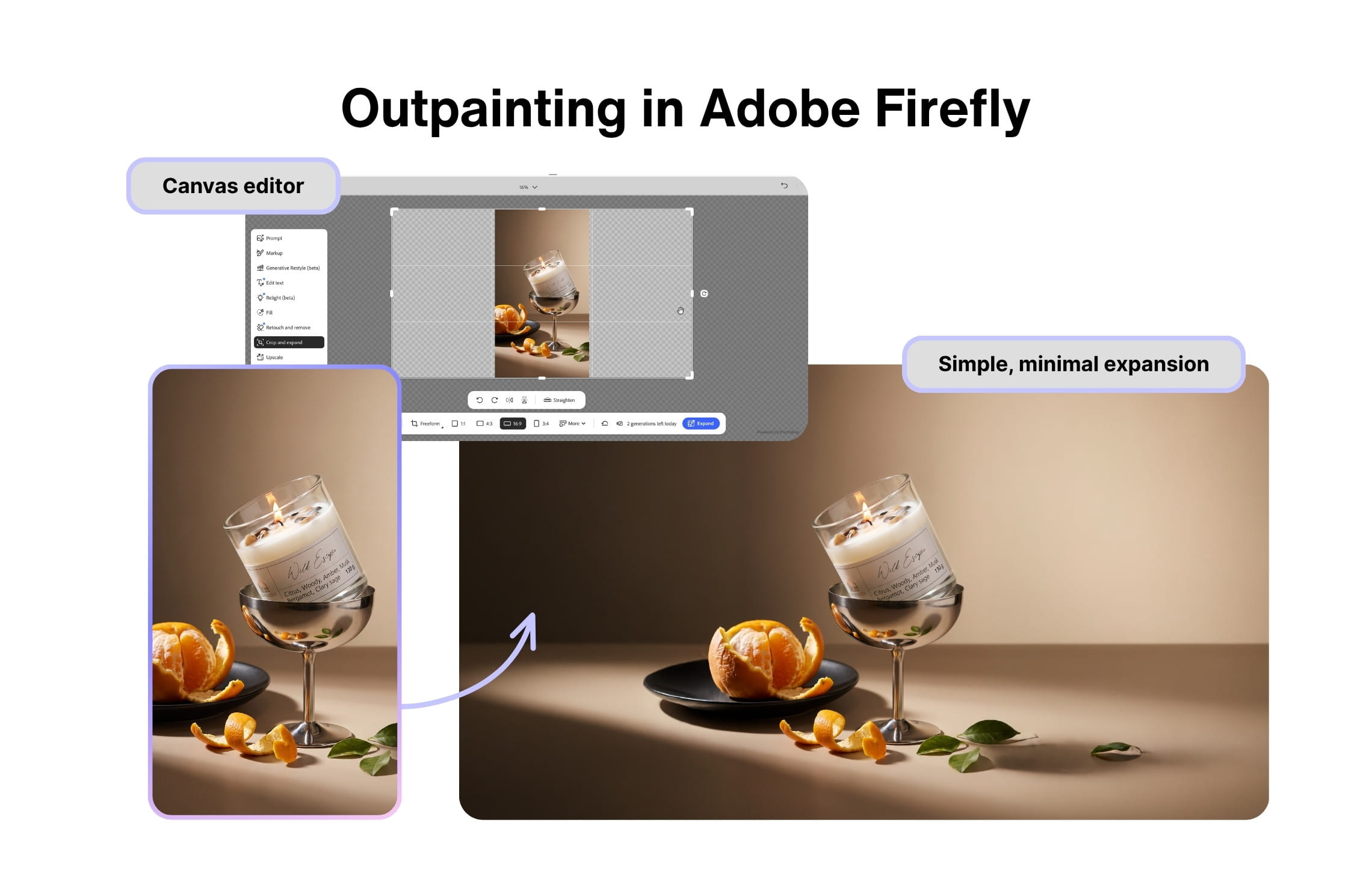
That matters for packaging, detailed textiles, jewelry, and other subjects where a small alteration can make the photograph inaccurate. An editor can retain the original product on a separate layer while generating or repairing the surrounding scene.
Photoshop is also more scalable than a desktop-only workflow suggests. Adobe’s Firefly Services include an expansion API, allowing businesses to generate different image formats through an automated process.
Key features
- Canvas-based Generative Expand
- Model choice through different editing routes
- Reference-guided corrections
- Detailed retouching and finishing
- Reusable layouts and assets
Pricing
- Free trial for Photoshop
- Photography plan: from $19.99/month with an annual commitment, including desktop Photoshop and Lightroom
- Photoshop standalone: from $22.99/month with an annual commitment
- Business and API workflows are separately priced
Verdict
Photoshop is worth considering when preserving the source product and making precise corrections are essential. It asks more of the editor than a simple expander, but provides useful control for demanding commercial images.
3. Photoroom, for seller workflows and batch image expansion
Photoroom puts expansion inside a product-image workflow rather than treating it as a separate creative experiment. Its Resize tool can change the canvas dimensions and use AI to fill the extra space around an existing background.
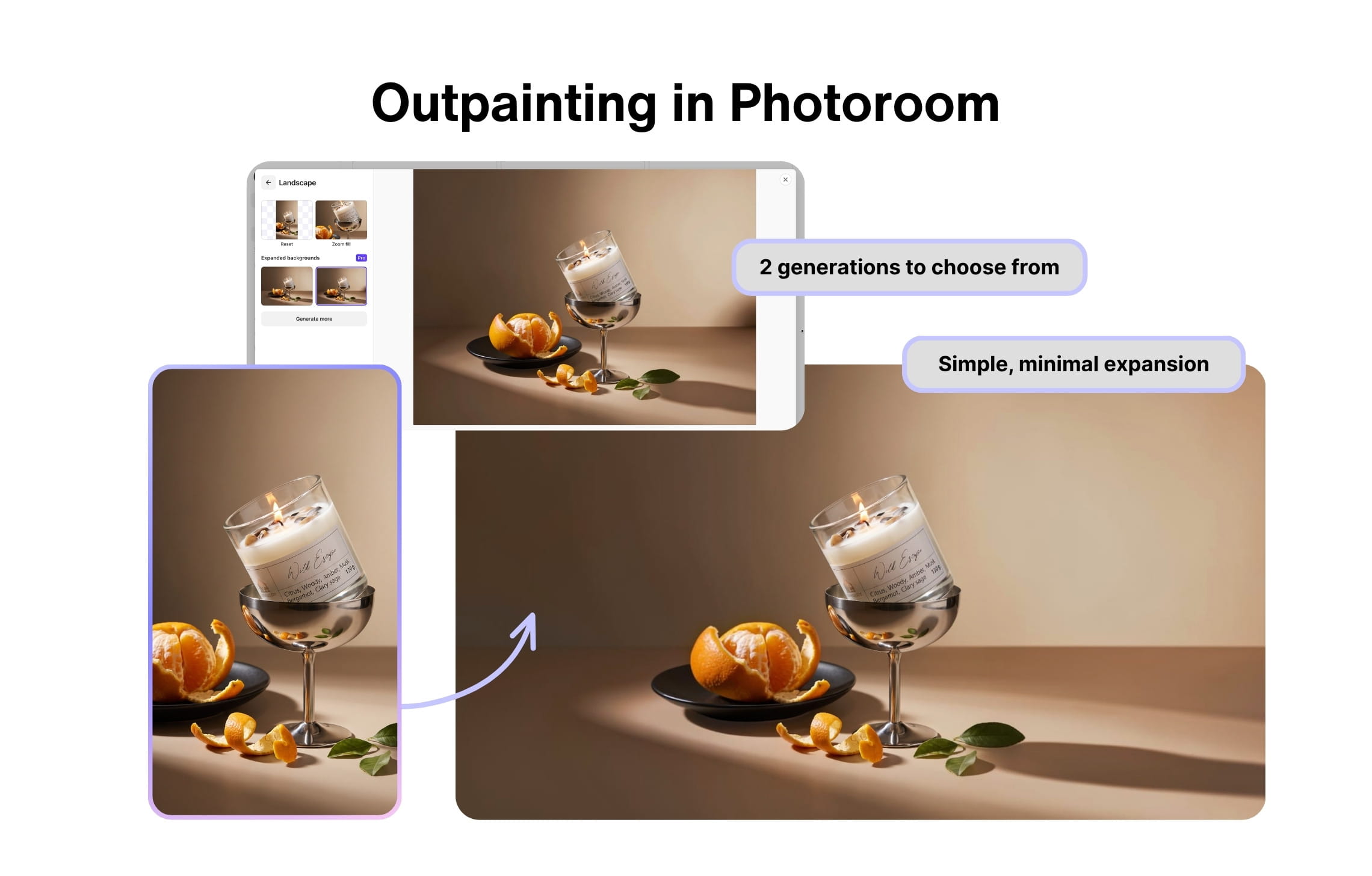
For sellers, the appeal is straightforward: adapt an image, make any remaining adjustments, and export it from the same workspace. The workflow is available across web and mobile.
For larger operations, batch editing can reduce repetitive setup, although each generated image still needs an appropriate review process. Solid-color backgrounds are handled differently from photographic backgrounds, so include both in your trial if your catalog uses both.
Key features
- Different ways to fit an image to a canvas
- Custom sizes and preset formats
- Batch expansion on the web
- Retouching and background adjustments
- Reference-based product correction
- Image enhancement and other operations
Pricing
- Limited free trial
- Pro: From $7.50/month with annual billing
- Max: From $20.99/month with annual billing
- Ultra: From $82.50/month with annual billing
- Custom pricing for enterprise
Verdict
Photoroom is a practical option for sellers and catalog teams that want expansion closely connected to resizing and product-image preparation. Its documented batch workflow makes it particularly relevant when the same format change must be applied repeatedly.
4. Picsart, for mobile editing and repeatable ad workflows
Picsart combines image expansion with mobile photo editing and tools for creating marketing visuals. Its AI Expand tool works on iOS, Android, and the web, letting you extend a photograph’s surroundings by adjusting the frame.
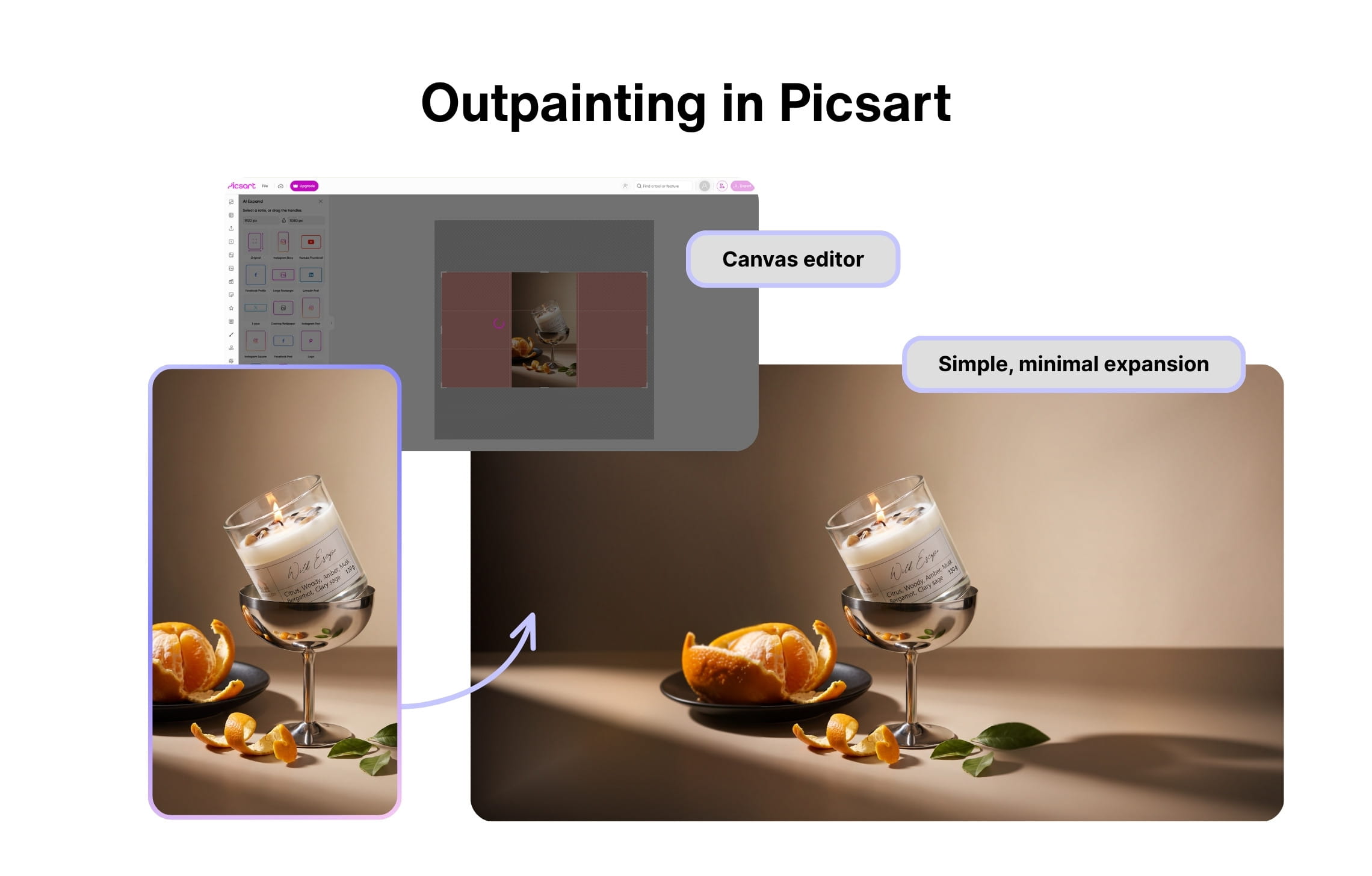
For sellers and social media teams, this makes it convenient to work with product photographs already on a phone. You can give a tightly cropped image more room, remove a distracting object, and add promotional text without moving between several applications. For example, extending the background above a skincare product can create space for an offer, while widening a fashion photograph can accommodate a campaign headline.
Picsart’s mobile editor also includes templates, background editing, and design elements. These make it useful when the expanded photograph is a starting point for a social post or advertisement, rather than the final deliverable.
For recurring production, Picsart Flow provides a separate workflow-building environment. You can connect an input photograph, an expansion step, and subsequent creative operations, then save the sequence for reuse. A team can use the same structure for another product or promotion without rebuilding every step. This makes the process repeatable, although each output still needs checking for product accuracy and composition.
Key features
- Prompt-guided outpainting
- Reusable production steps
- Cleanup and localized replacement
- Enhancement and other image-editing tools
- Text, templates, and design elements
- Reusable workflows: connect editing and generation steps, choose supported models, and save the sequence for future inputs
Pricing
- Free access with limited functionality
- Pro: $15/month, or $10.50/month with annual billing
- Ultra: pricing varies by the selected credit allowance and number of seats
- Separate plans for enterprise and API use
Verdict
Picsart is worth considering for repeatable product-ad production, especially when expansion leads into additional creative steps. Judge the expanded image independently from the finished advertisement so layout polish does not hide product inaccuracies.
How to choose an AI image extender for ecommerce
The right tool depends on how much of the photograph must remain untouched, what the final image needs to contain, and how often your team repeats the task.
Decide whether you need expansion or a new composition
If the source photo already works, aim for a restrained continuation of its background. A different setting, camera angle, or product arrangement is a broader editing task.
Canvas-based expansion is useful when you know precisely where the new space belongs. Prompt-based editing is useful when the brief involves composition and context, but it may require closer inspection of the original subject.
For replacing the setting rather than extending it, a background changer may be more appropriate.
Put product preservation ahead of background detail
Inspect the elements that identify the SKU: packaging text, logo placement, colors, dimensions, stitching, hardware, and material texture.
A convincing room or countertop should not compensate for a changed product. For detailed packaging or fashion imagery, compare enlarged crops of the original and edited subject.
Where exact preservation is essential, consider a layered workflow that retains the original product pixels.
Check framing, dimensions, and output resolution separately
An image can have the correct aspect ratio but still be unsuitable for the final placement.
Check whether the product occupies the right amount of the frame, whether there is enough space for text, and whether the export has sufficient resolution. A wide image with a tiny product is not necessarily a successful banner.
Use canvas or export settings for exact dimensions wherever possible. A written instruction requesting a particular pixel size is not a substitute for checking the downloaded file.
Compare the cost of an approved image
Subscriptions and credit allowances are only the starting point.
During a trial, track how many generations you need, how much correction is required, and whether higher-resolution output costs more. Include export restrictions and commercial-use conditions.
A useful measure is the combined generation and editing cost per approved image. This is more informative than comparing the cheapest monthly plan or the largest advertised credit allowance.
Evaluate scale without assuming every feature is automated
For recurring catalog work, confirm that the platform supports your particular expansion workflow at the required volume.
Look for consistent framing rules, supported batch operations, appropriate API access, and a way to review exceptions. Team seats and shared storage help collaboration, but they do not establish automated processing on their own.
If your team needs finished images rather than another editing system to manage, compare a managed production service with a software subscription. Our guide to product photography services explains the different options.
Create more usable product images with Claid
Use Claid AI to explore wider compositions and extend the surroundings of existing product and fashion photos. Continue with image enhancement, cleanup, and formatting to prepare the final assets.
For a larger project or custom requirements, our AI product photography service can handle production from your source images and brief. Share your references, brand requirements, and delivery formats, and our team can create, review, and deliver product photos and videos for your channels.
FAQ
Can I expand a product photo without changing the product?
That is the goal, but the level of preservation depends on the workflow. Generative editing can alter details even when instructed not to. Compare the result with the source, and use masks or a retained original product layer when stricter control is needed.
What is the difference between an image extender and an upscaler?
An extender generates additional content outside the original frame. An upscaler increases the resolution of the image. You may need both, but expansion alone does not guarantee that the product becomes sharper.
Can AI uncrop a photo back to its original version?
Not reliably. AI generates a plausible continuation rather than recovering the original missing content. If the full photograph is available, use it instead.
Can I extend fashion photos with people in them?
Yes, but inspect both the clothing and the person. Start with a source that already shows the important garment details and body parts. Extending a wall or floor around a complete subject is a different task from inventing a cropped hand, sleeve, or shoe.
Are free AI image extenders suitable for ecommerce?
They can be useful for evaluation and occasional work. Before publishing, check export quality, watermarks, usage allowances, and commercial-use conditions. A free preview does not necessarily include everything needed for ongoing production.
Need AI expansion for high-volume catalogs?
Automatically extend backgrounds, fix awkward crops, and adapt product images to new aspect ratios across your catalog. Use the API for a controlled setup, or let our team manage the workflow from input to final assets.


Claid.ai
October 22, 2026