Tech
Should you build or buy an AI image processing pipeline? [2026]

![Picture for Should you build or buy an AI image processing pipeline? [2026] article](/static/da1b40495b1c6848c81d1d2d8ab1861e/91943/ai_image_pipeline_buy_or_build_b8ef1e6016.webp)
Most teams should buy first and build later. For standardized image work, a managed API is the rational default. When the work gets too specific for a standard API but isn’t worth building in-house, a provider-built custom workflow is usually the next step. You only move to serverless inference or self-hosting when cost, latency, quality control, or throughput give you a concrete reason to own more of the stack.
The reason the question is hard is that “build vs buy” hides a four-way decision, not a binary: a managed API, serverless inference, a provider-built custom workflow, or fully self-hosted infrastructure. The right one depends on your volume, how custom the work is, and whether you have the ML infrastructure to run it yourself.
Scale moves the answer most. A setup that’s irrational at 10,000 images a month can be reasonable at 1 million and obvious at 20 million, but only if the workload stays predictable enough to keep your GPUs busy.
This guide maps each path, runs the cost math at 10K, 100K, and 1M images per month, and gives you the questions that decide it.
Build-vs-buy problem has actually 4 solutions
Image processing is not one workload. It can include background removal, enhancement, image generation, product detection, cropping, and many other operations.
Some of these operations are commodity infrastructure. Others may encode your company’s product logic, brand standards, marketplace rules, or proprietary data.
For example, a marketplace probably should not build its own generic background remover at 50,000 images per month. But if that marketplace has proprietary product taxonomy data, strict category-specific image rules, and a quality model that improves conversion, then it may make sense to own the decision layer around the pipeline.
With that said, apart from buying an API and building your own product, there’s also a third path of serverless GPU inference layers and a fourth path of provider-built custom workflows.
Buy-vs-build decision: a quick overview
Here’s a brief decision map for 4 options:
- Use a managed API when you need a reliable image operation quickly
- Use serverless inference when you want to run your own model without managing GPU servers
- Use a provider-built custom workflow when the hard part is the full production process, not just the model
- Self-host when scale, latency, privacy, or differentiation justify owning the infrastructure
| Managed API | Fastest path, least operational burden, lowest control |
|---|---|
| Serverless inference layer | More control, moderate engineering burden, variable cost |
| Managed custom workflow | Best for a bespoke visual pipeline without internal engineering effort |
| Self-hosted pipeline | Maximum control, highest operational burden, best economics at high scale |
Now, let’s review each option in closer detail.
When managed API wins
Managed APIs are especially strong when the workload is:
- Low or moderate volume
- Spiky rather than steady
- A standardized task
- Needed quickly
- Not a core product differentiator
- Owned by a team without dedicated ML infrastructure staff
- Hard to forecast
- Part of an early-stage product experiment
Use cases include background removal for seller uploads, upscaling occasional user-generated images, enhancing product photos for a small catalog, or testing AI-generated backgrounds before committing to a larger workflow.
Example: automated image upscaling as additional offering
Assume a printing company needs image upscaling for customer uploads. The task matters, but it is not the company’s core product. The engineering team has backend and product engineers, but no dedicated MLOps function.
For this company, a managed API is usually the right call. Even at thousands per month in API spend, the alternative will take a lot more resources.
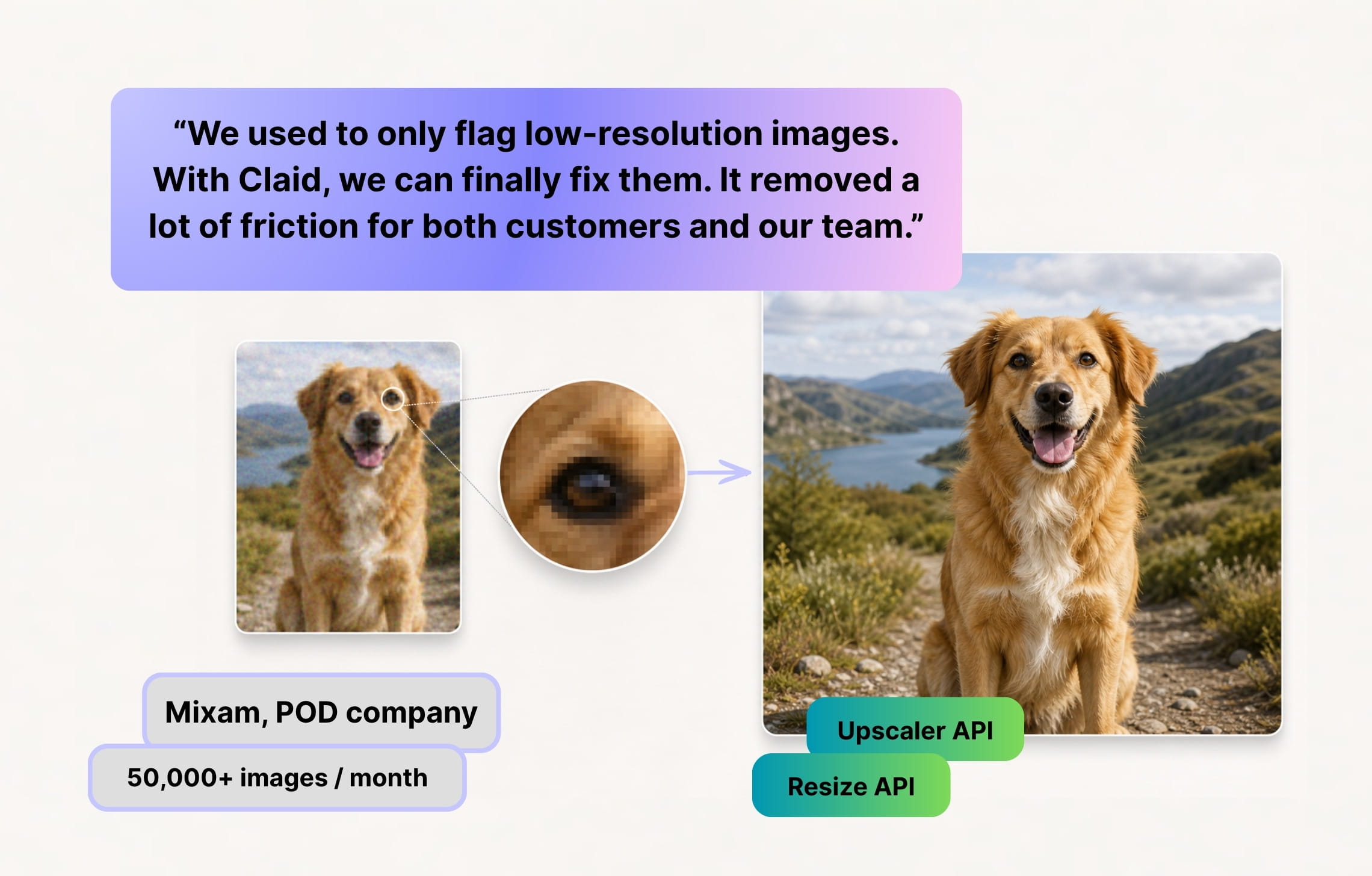
For instance, Mixam integrated Claid’s APIs into its prepress workflow to automatically upscale user-uploaded photos and artworks to print-ready 300 DPI, extend missing bleed, and preserve color consistency. The result: 78% fewer quality-related complaints at 50,000+ images processed monthly.
One of the important things here is speed. While the first production-ready self-hosted version can easily take 4–6 months, API can be implemented right away.
On top of that, even a lean implementation has opportunity cost. If the same engineers could spend that time on revenue-generating product work, the API is way simpler and cheaper.
Verdict
Managed API wins when the business needs the result, not the infrastructure.
For standardized image operations at 10,000–100,000 images per month, API is usually the default unless there are strict privacy, latency, or customization requirements.
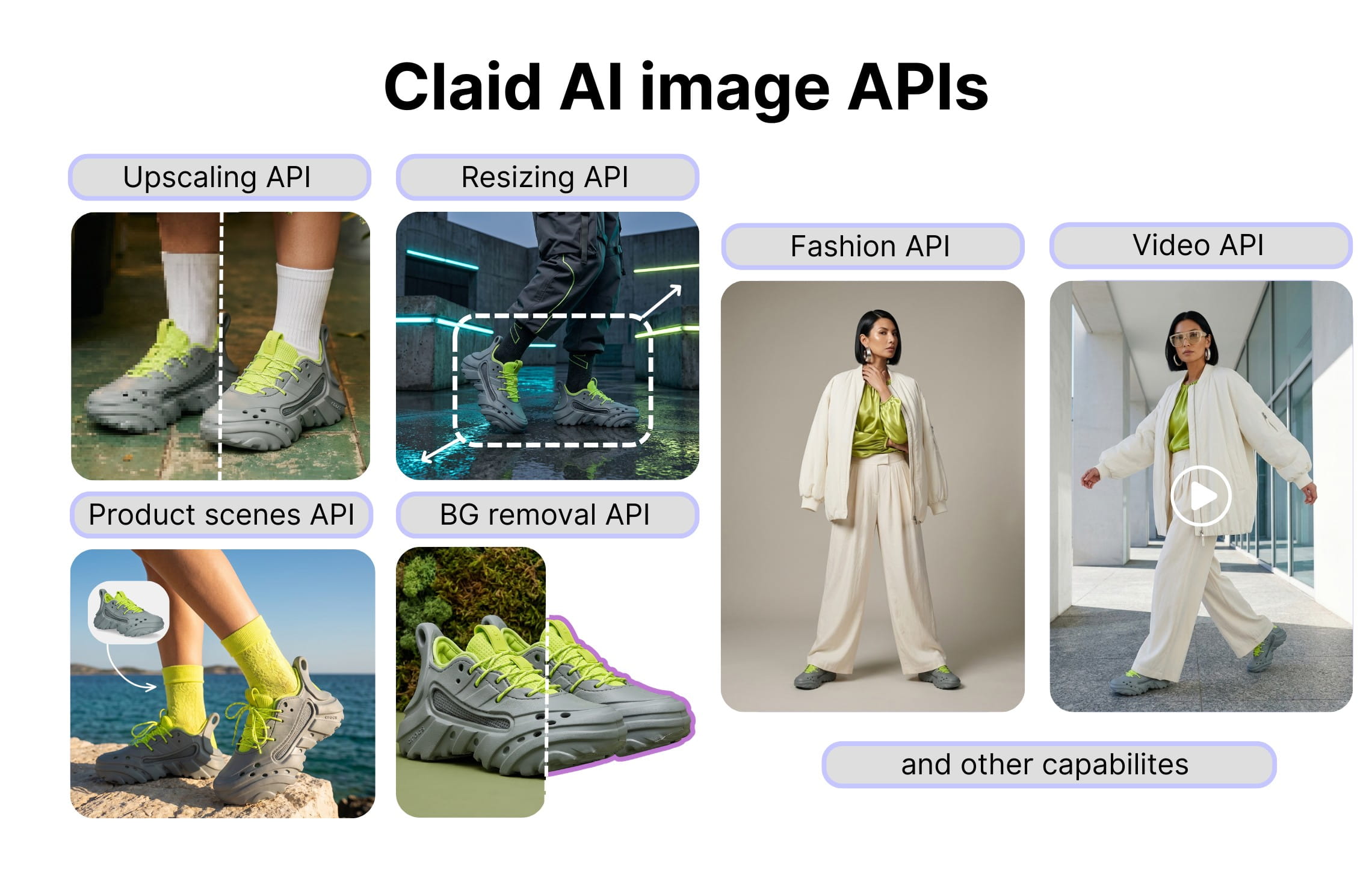
Check out Claid’s AI image APIs or reach out to us if you need customized pipelines.
When self-hosting wins
Self-hosting becomes attractive when the workload is large, stable, differentiated, or strategically sensitive.
The common triggers are:
- 1M+ images per month
- High and predictable utilization
- Differentiated image processing logic
- Proprietary training data
- Strict data privacy or data residency requirements
- Need for custom model weights
- Tight latency requirements
- Deep integration with internal ranking, search, moderation, or catalog systems
- A team that already has ML infrastructure competence
For example, self-hosting can make sense for use cases like real-time visual search, interactive editing, compliance checks before listing publication, upload-time moderation, or internal quality scoring that needs to run close to the product experience.
Example: marketplace processing 20M images per month
Let’s imagine a large-scale marketplace that enhances every seller image, detects product type, applies category-specific transformation rules, generates platform-compliant outputs, and uses image quality as a conversion lever, then the economics change.
At 20 million images per month, even a low per-image API price can become a large recurring cost. If the workload is steady enough to keep GPUs highly utilized, a dedicated inference cluster may beat managed API pricing on marginal cost.
But this only works if the company can actually operate the system well. A poorly utilized GPU cluster can be more expensive than an API.
Verdict
DIY wins when ownership creates economic leverage or product advantage, especially when latency is particularly important for real-time product experiences and image quality is a differentiator.
If you process more than 1M images each month, self-hosting becomes worth modeling, but not automatically worth doing. Provider-built custom workflows can also do the job in many cases.
When serverless inference wins
Serverless inference is useful when the team wants more control than a managed API, but does not want to operate long-lived GPU infrastructure.
It works well when:
- You want to run a specific open-source model
- You need custom pre-processing or post-processing
- You want to avoid idle GPU capacity
- Traffic is variable, but the team can tolerate some cold-start behavior
- You have engineers who can own the pipeline
- You are experimenting before committing to self-hosting
Platforms such as Replicate, Modal, RunPod serverless, fal.ai, and similar infrastructure providers sit between fully managed APIs and fully self-hosted infrastructure. This can reduce infrastructure burden, but it does not eliminate engineering work.
Verdict
Serverless inference wins when your team wants to own the model and workflow logic, but not GPU server management.
When custom workflows win
Managed custom workflows win when the company needs automation, but the hardest part is turning messy visual inputs into consistent outputs that follow business rules.
This is common in ecommerce, fashion, automotive, food delivery, real estate, and other visual-heavy industries.
A custom workflow can include a lot of operations: catalog scanning, input quality checks, background removal and replacement, upscaling, cropping and resizing, photo and video generation according to the category-specific logic, marketplace formatting, etc.
Example: fashion catalog production
A fashion brand may need to produce a full catalog set from inconsistent product inputs: clean flatlays, on-model images, campaign-style shots, and marketplace-ready exports. Each SKU may need specific poses, approved backgrounds, crop rules, model requirements, and quality checks.

For example, Claid built a multi-layered fashion workflow for Kasta, combining face swaps, flatlay-to-model generation, and multiple poses per garment. The result was 3x faster processing, realistic on-model images without reshoots, 100% product preservation, and smooth integration back into the catalog through preserved data structures.
A managed API can help with individual operations, but it will not decide which output each SKU needs or how to apply brand rules across the catalog. A custom workflow is a better fit when the goal is to turn product inputs into a repeatable visual production system.
Example: marketplace image standardization
A marketplace may receive thousands of inconsistent seller images every day. Some images need background removal, some need enhancement, and some should be rejected. Some need category-specific crops or marketplace-compliant resizing.
A managed API can perform individual operations. Serverless inference can run models. But the marketplace still needs logic for deciding what happens to each image. This is where a managed workflow becomes useful: it can combine image intelligence, transformation logic, category rules, QA, and export settings into one repeatable process.
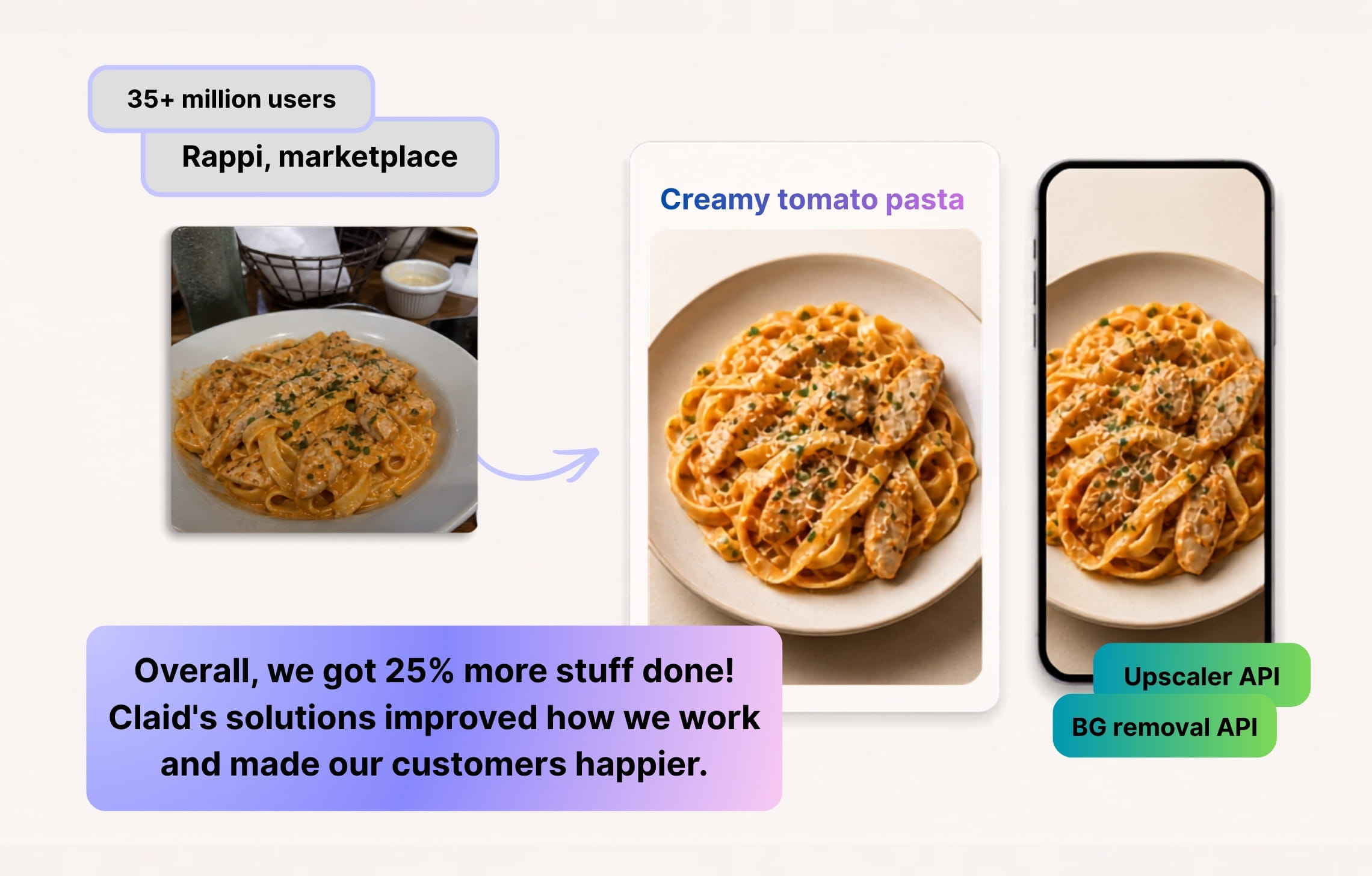
For example, Rappi used Claid’s API to automate image enhancement inside its CRM and onboarding workflow, improving food photo resolution, clarity, color, and lighting in batches. This helped reduce average restaurant onboarding time from 9 days to 1.2 days and save 42% of photo editing time.
Verdict
Managed custom workflows win when the business problem is specific, repeatable, and valuable, but not worth turning into a full internal infrastructure project.
Instead of buying raw API calls or running models on serverless GPUs, a team can work with a provider like Claid that builds and operates the visual pipeline around the business goal.
Cost math: 10K, 100K, and 1M images per month
Assuming the workload is AI upscaling, let’s compare the approximate economics of managed APIs, serverless inference, provider-built custom workflows, and self-hosted infrastructure at three monthly volumes: 10K, 100K, and 1M images.
Note that these numbers are only estimates: the real cost will depend on the resolution, model type, latency requirements, vendor discounts, and other aspects.
Scenario 1: 10K images per month
At 10,000 images per month, managed API clearly wins.
A managed API might cost roughly $200–$1,500 per month for AI upscaling, depending on provider and quality tier.
A self-hosted setup is rarely rational at 10K images per month. Even a small dedicated setup creates fixed overhead. A realistic self-hosted solution can land around $4,000–$10,000 per month once partial engineering allocation, monitoring, maintenance, and reliability work are included.
Scenario 2: 100K images per month
At 100,000 images per month, managed API is favored for most commodity tasks, while managed custom workflow is the best fit when the business rules and output value justify it.
A reasonable total-cost comparison might look like this:
- Managed API: $1,500–$12,000 / month
- Serverless inference: $700–5,000 / month in platform cost plus engineering time
- Self-hosted: $10,000–18,000 / month
For standardized workloads, managed API is more rational. Self-hosting at this scale is usually justified only when the team needs custom model behavior, internal data control, or specialized processing that an API cannot provide.
Custom workflows can be the most relevant option here, especially for such use cases:
- A marketplace processing seller uploads
- A fashion brand generating full catalog sets
- A food delivery platform improving restaurant visuals
- An automotive platform standardizing dealer photos
- A real estate platform enhancing property images
Scenario 3: 1M images per month
At 1 million images per month, raw GPU economics can start to favor owning more of the stack.
Managed API spend for AI upscaling or enhancement may range from $10,000–$80,000 per month, depending on vendor, operation complexity, resolution, SLA, and enterprise discounts.
Serverless inference may land around $5,000–$15,000 per month in platform cost. It can be cheaper than a managed API, but you still need to consider the resources of your internal team.
Self-hosting can begin to look attractive here.
Realistic self-hosted TCO may be closer to $12,000–$35,000 per month, but the key variable is utilization.
If GPUs are running at 70%+ effective utilization, self-hosting may become competitive. If utilization drops below 40%, the economics can deteriorate quickly. Idle GPU is wasted money. API pricing and serverless inference scale more naturally with actual usage.
Managed custom workflows can also fit at 1M images per month, but only if the scope is operationally meaningful.
Cost math comparison
Here’s a simple comparison for AI upscaling or enhancement workloads:
| Dimension | Managed API | Serverless inference | Managed workflows | Self-hosted |
|---|---|---|---|---|
| Cost at 10K images/month | $200–$1,500 | $100–$700 + engineering | Scoped* | $4,000–$10,000 |
| Cost at 100K images/month | $1,500–$12,000 | $700–$5,000 + engineering | Scoped* | $10,000–$18,000 |
| Cost at 1M images/month | $10,000–$80,000 | $5,000–$15,000 + engineering | Scoped* | $12,000–$35,000 |
| Time to production | Days | 1–2 weeks | Weeks, depending on scope | 4–6 months |
| Custom business rules | Limited | Possible, customer-built | Strong | Full |
| Engineering burden | Low | Medium | Low to medium | High |
| Data privacy | Shared infrastructure | Shared infrastructure | Full control | Full control |
| Best for | Standardized image operations | Custom model execution | Bespoke visual pipelines | Fully owned infrastructure |
* Custom workflows are priced by scope, not just by volume, so they don’t map to a per-image tier. They typically land between managed API and self-hosted at a comparable volume: you’re paying for pipeline design and operation, not raw compute.
Questions to ask before deciding
Before choosing managed API, serverless inference, or self-hosting for enterprise automation, companies should ask five major questions.
1. Do we have a dedicated ML engineer or infrastructure owner?
If you don’t, use a managed API. Without an owner, the system will either stagnate or become a hidden reliability risk.
2. Is image quality a published differentiator in our product?
If yes, consider owning more of the pipeline logic.
This does not always mean self-hosting. It may mean owning evaluation criteria, output standards, business rules, and QA, while using APIs or a custom workflow partner for execution.
3. Is the workload steady enough to keep GPUs utilized?
If not, avoid self-hosting. For spike-heavy workloads, managed APIs or serverless inference are often better.
4. Do we need customization?
If you need custom model weights, proprietary training data, and full inference control, self-hosting may be the right path.
If you need business rules, brand rules, category logic, QA, and custom outputs, a managed custom workflow may be the better path.
If you only need one standard operation, use an API.
5. Would a 4–6 month infrastructure project be the best use of our engineering roadmap?
If not, buy. Even if self-hosting can save $2,000-5,000 per month, it may not be worth delaying roadmap work that could generate more revenue, improve retention, or unblock customers.
Buy-vs-build: a practical decision framework
| Choose managed API |
|
| Choose serverless inference |
|
| Choose provider-built custom workflows |
|
| Choose self-hosting |
|
Claid spans two of these four paths, the managed API and provider-built custom workflows, which is why it shows up on both sides of this comparison.
Want to build a custom workflow with Claid? Or need help deciding? Let’s schedule a call, and we’ll guide you through possible options.
FAQ
Is building an AI image pipeline cheaper than using an API?
Not at low or moderate volume. Self-hosting usually becomes worth evaluating seriously at high volume, especially when the workload is stable and utilization is high.
When does self-hosting start to make sense?
Usually when you process millions of images per month and the workload is predictable. A rough trigger is 1M+ images per month for serious evaluation and 5M+ images per month for stronger self-hosting economics. But volume alone is not enough. You also need high utilization, internal ownership, and a reason to control the pipeline.
Is serverless inference the same as a managed API?
No. A managed API gives you a finished operation. Serverless inference gives you a way to run a model without managing GPU servers.
With serverless inference, your team still owns model packaging, workflow logic, retries, monitoring, quality control, and versioning.
Where do managed custom workflows fit?
Managed custom workflows fit when the company needs a tailored visual production process.
This is useful when the pipeline includes messy inputs, image intelligence, business rules, brand constraints, QA, and specific export requirements. It’s not the same as buying API calls. It’s closer to outsourcing the design and operation of the visual workflow.
What is the safest default in 2026?
Start with managed APIs for standard operations and adopt provider-built custom workflows when the process is too specific for a standard API but not worth building internally. If this approach creates bottlenecks in cost, latency, quality control, or throughput, evaluate serverless inference or self-hosting. Reach out to us if you have doubts or questions about API integration and custom workflows at scale.
Need this at scale?
Process thousands of images via API, or let our team handle it for you.


Claid.ai
June 18, 2026