Tech
9 best background removal tools in 2026


The choice of the best background remover depends on what happens after the cutout. A casual seller may need one transparent PNG, while an ecommerce platform may need thousands of consistently framed images delivered through an API.
In this guide, we compare the leading background removal tools by output quality, workflow features, pricing, privacy, and ability to scale.
Quick comparison of the best background removers
Pricing may be subject to change and may vary by region, billing cycle, usage volume, and negotiated enterprise terms.
| Tool | Best for | Pricing |
|---|---|---|
| Claid | Ecommerce catalogs, marketplaces, and custom image workflows | Free trial; From $9/month |
| Slazzer | Dedicated background removal through apps, plugins, or API | 2 free credits; From $11/month for 100 images |
| Photoroom | Sellers and teams creating listing-ready product images | Free plan; From $7.50/month |
| Canva | Marketers creating designs after removing a background | 1 free removal; From $15/month or $144/year |
| Adobe Photoshop and Express | Designers who need automatic removal plus manual refinement | Express Free; Express Premium is $9.99/month; Photoshop is $22.99/month |
| Pixelcut | Small sellers, creators, and mobile-first teams | Free plan; From $8/month |
| Clipdrop | Designers who want several fast browser-based AI editing tools | Free plan; From $15/month |
| NoBG.space | Free, private, on-device background removal | Browser tool is free; API is $0.01 per successful image |
| withoutBG | Developers who want an open model or self-hosted deployment | Open model is free; managed API starts at €0.10 per image |
Need this at scale or as a custom workflow?
Handle background removal at scale without adding manual work to your team. Automate the process through our API, or let our team manage it for you.
1. Claid.ai, for ecommerce image workflows
Claid.ai offers background removal as an operation in a larger product-image pipeline. In the platform, you can create transparent cutouts, standardize framing, resize images, generate shadows, and enhance resolution without moving files between separate applications.
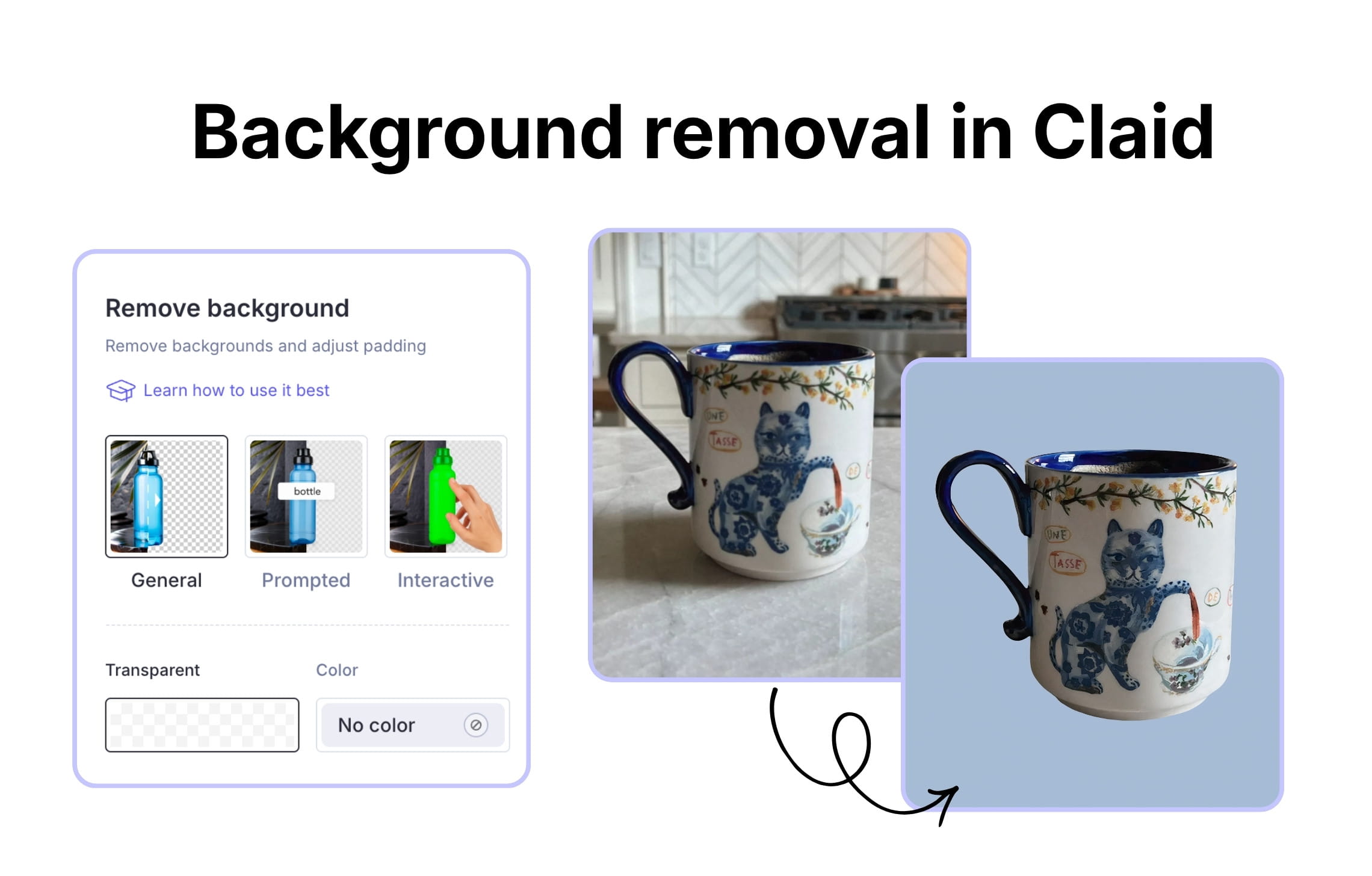
The background removal tool has an automated mode that handles straightforward products and people, while interactive and prompted removal provide more control over the subject that should remain. This is useful when an image contains several objects, props, hands, or display fixtures that could confuse a basic one-click tool.
Through the background removal API, teams can return a transparent PNG, apply a solid background, and preserve safe space around the product. More importantly, you can combine removal with other image operations in customizable API workflows.
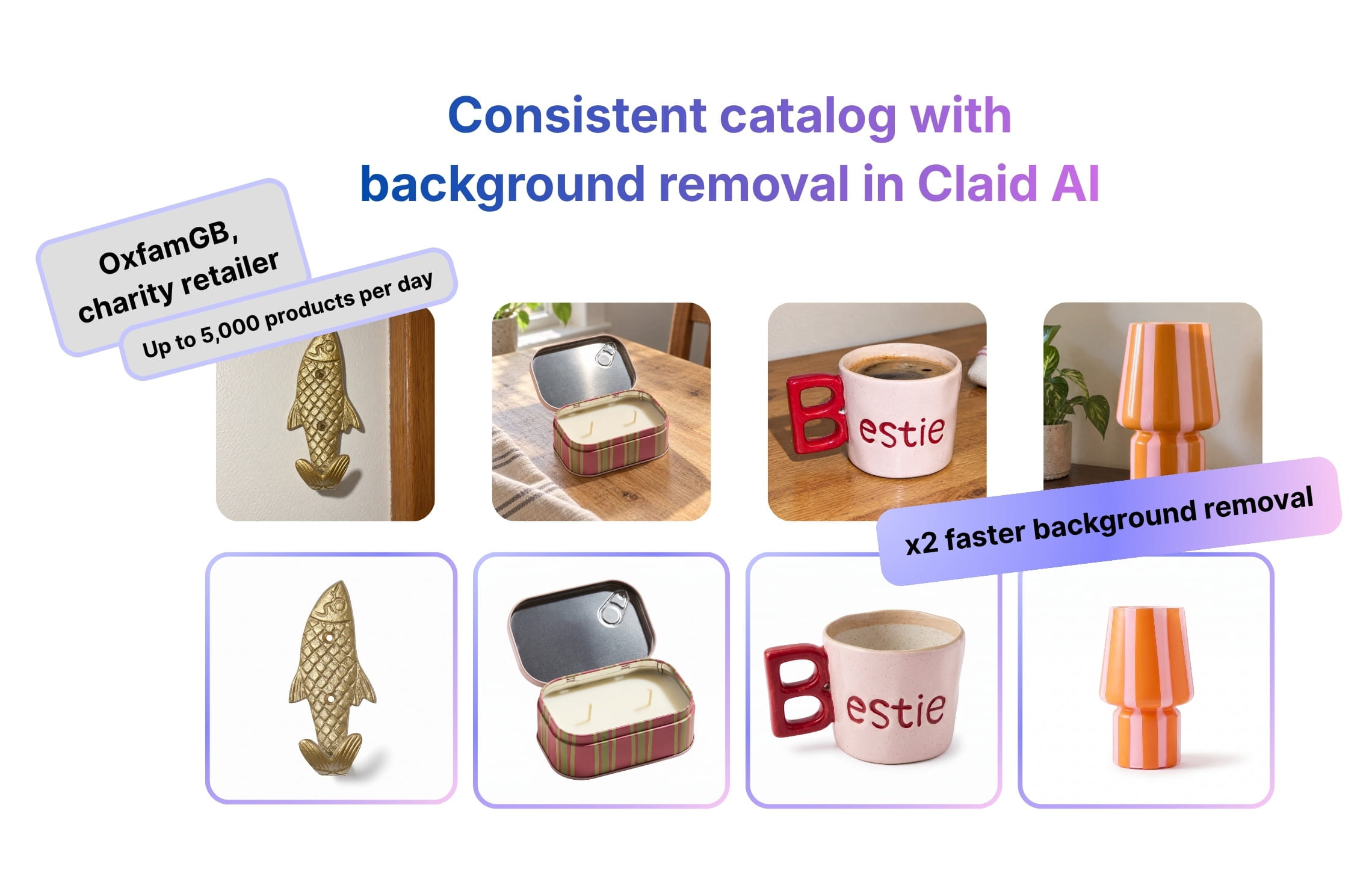
A large-scale charity retailer Oxfam GB uses Claid’s AI background removal and reduced average removal time from 33 seconds to 15 seconds. A delivery platform Zepto used a custom Claid pipeline to standardize a catalog of more than 45,000 products.
Key features
- Automated, interactive, and prompted background removal
- Range of AI image tools for catalog-ready assets
- Background removal API chained with other APIs if needed
- Custom enterprise workflows
Best for
- Marketplaces processing mixed seller uploads
- Retailers standardizing large or frequently changing catalogs
- Product teams embedding image preparation into an application
Pricing
- Free trial with 50 web credits and 50 API credits
- Paid plans starting from $15 monthly or $9/month billed annually for 500 web credits
- Enterprise pricing is based on volume, requirements, and support
Verdict
Claid is the strongest fit when background removal must become a repeatable ecommerce operation rather than remain an isolated editing task. It is less suitable for someone who only wants unlimited free cutouts or entirely local processing.
2. Slazzer, for bulk processing and API integrations
Slazzer focuses on automatic background removal across a website, desktop application, Android app, plugins, integrations, and REST API.
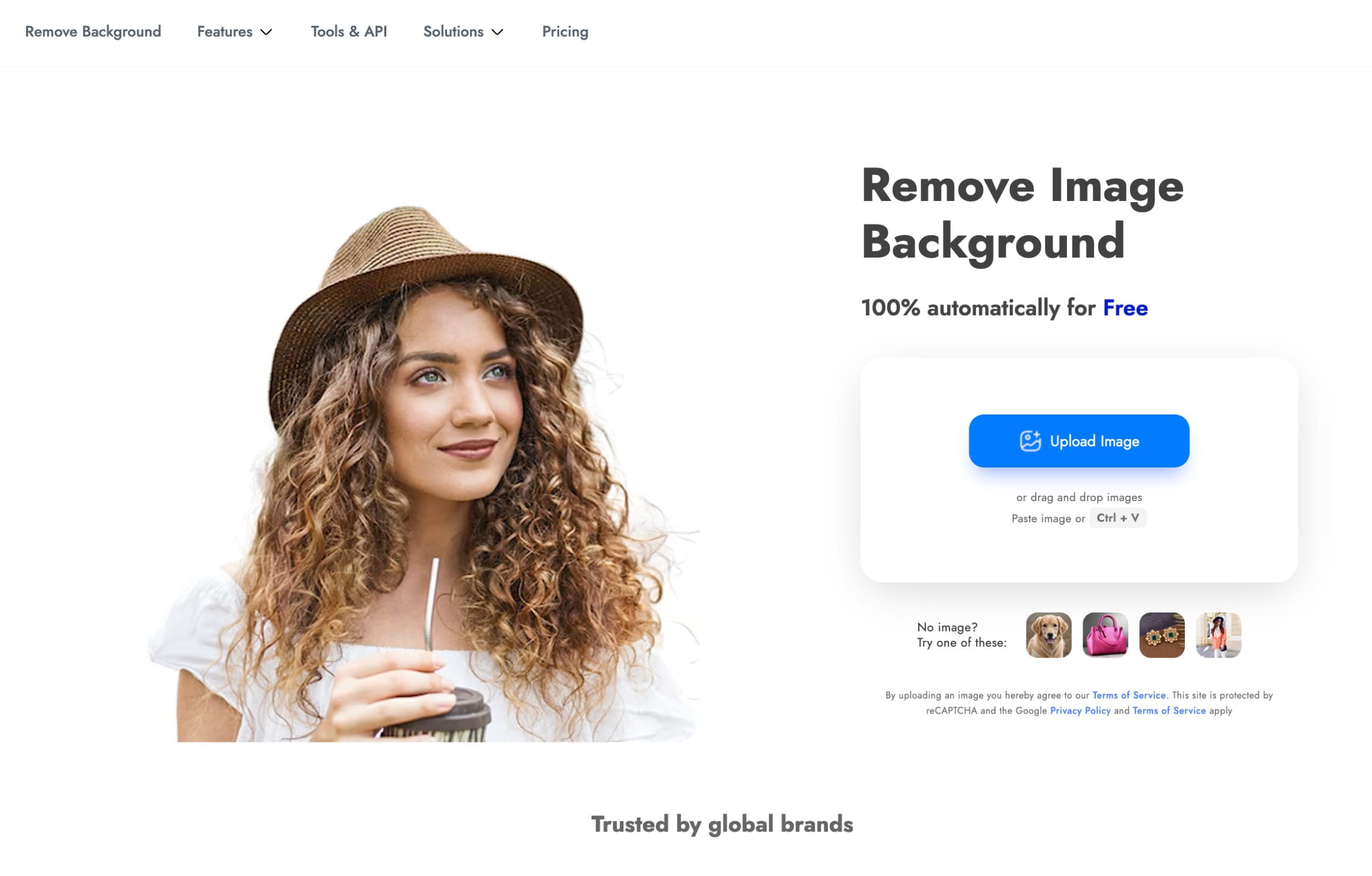
The desktop application can process folders on Windows, macOS, or Linux, while plugins connect the service to Photoshop, Figma, Sketch, WooCommerce, and Zapier. The API can return transparent PNGs or JPEGs with a selected background color and supports images up to 25 megapixels.
Slazzer publishes unusually specific throughput guidance. Its standard API can process up to approximately 500 one-megapixel images per minute, with lower limits for larger files. Enterprise customers can request higher limits, multiple API keys, customized models, quality guarantees, dedicated support, or an on-premise deployment.
Key features
- Dedicated cutout API
- Desktop batch processing
- Creative and ecommerce integrations
- On-premise option (organizations with strict data or infrastructure requirements can deploy the technology within their own environment)
- High-volume rate limits (500 small images per minute)
Best for
- Teams replacing a dedicated background-removal API
- Businesses processing large folders through a desktop interface
- Enterprises that require an on-premise option
Pricing
- Two free full-resolution credits and unlimited low-resolution website previews
- Subscriptions start at $11/month for 100 images
- Enterprise plans for processing more than 100,000 images annually
- Pay-as-you-go top-ups
Verdict
Slazzer is a sensible option when the primary requirements are reliable cutouts, broad integrations, and a clear path from desktop batches to enterprise APIs. It offers fewer connected product-photography capabilities than Claid or Photoroom.
3. Photoroom, for sellers who want templates and batch editing
Photoroom combines background removal with product staging, AI backgrounds, retouching, shadows, virtual models, and marketplace-oriented templates. Its visual workflow is particularly accessible to sellers who want listing-ready images without building an image-processing pipeline.
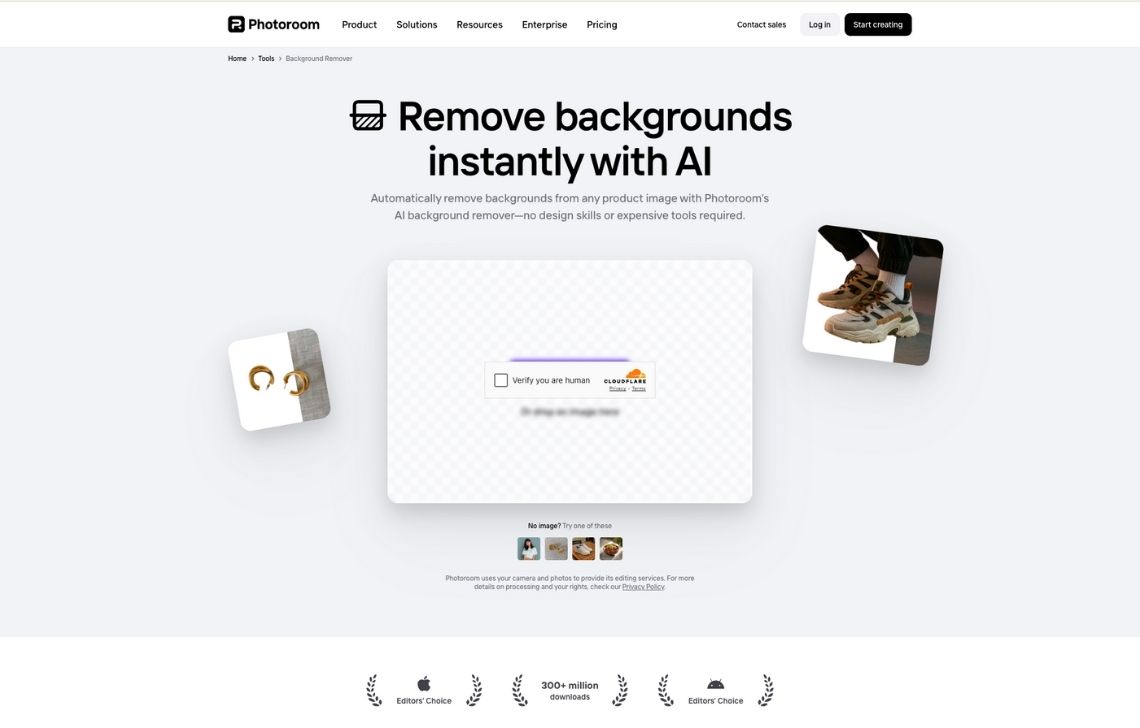
Paid plans include monthly export allowances ranging from 1,000 on Pro to 10,000 on Ultra. The core background remover does not consume generative AI credits, although exports remain subject to plan limits and fair-use policies.
For automation, Photoroom offers a dedicated Remove Background API. Enterprise plans require an annual commitment covering at least 200,000 images and add volume pricing, Visual QA, onboarding, security controls, support, and service-level commitments.
Key features
- Product-oriented background removal
- Product staging and backgrounds
- Uncertainty scoring
- Batch processing
- Enterprise quality control
Best for
- Marketplace sellers and growing ecommerce brands
- Catalog teams that prefer a visual editor
- Businesses combining mobile, browser, batch, and API workflows
Pricing
- Free plan with limited usage
- Paid plans start from $7.50/month billed annually, with 1,000 monthly exports
- Remove Background API: $0.02 per image
- Custom enterprise pricing
Verdict
Photoroom offers a strong bridge between creator-friendly editing and catalog automation. It is less flexible than a custom workflow platform when a business has unusual routing, validation, or multi-step processing requirements.
4. Canva, for background removal inside a design workflow
Canva’s background remover is designed for people who want to isolate a subject and immediately use it in an advertisement, presentation, social post, flyer, or template. After automatic removal, erase and restore brushes allow basic corrections to the mask.
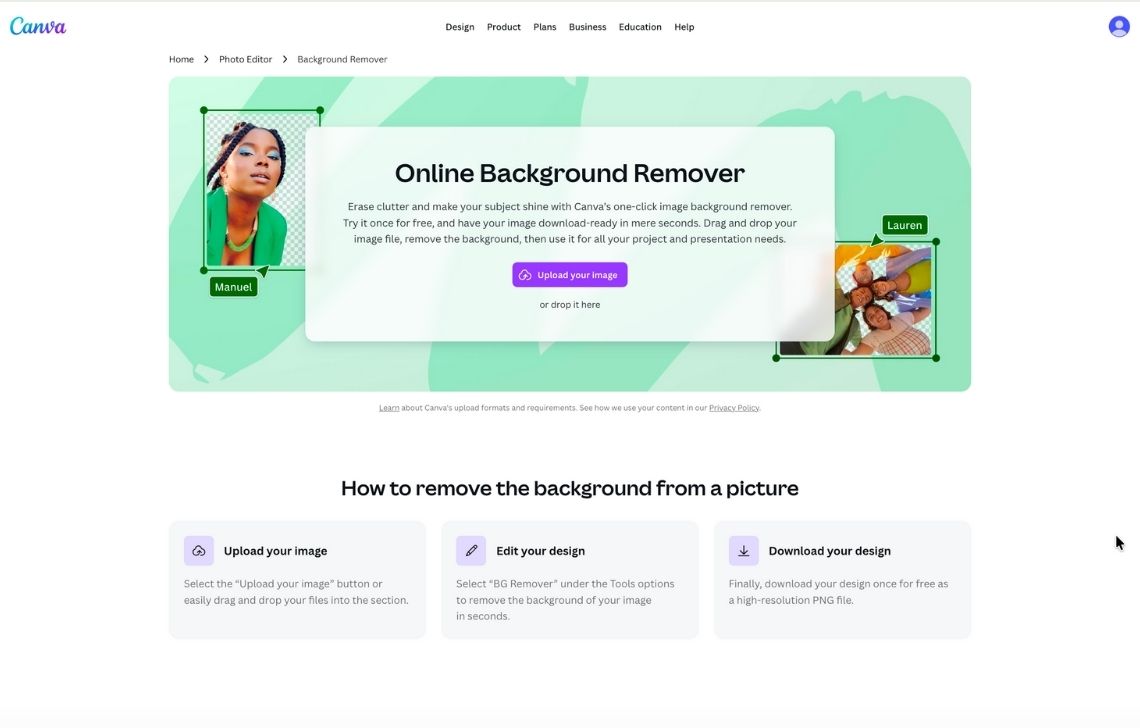
Canva also supports image and video background removal. Paid users can process uploaded images from a project folder, although each folder batch is limited to 50 images. This works for campaign production but is not equivalent to a catalog-processing API.
Canva Business and Enterprise add shared workspaces, brand governance, approvals, administration, SSO, SCIM provisioning, and custom integrations. These controls help large creative organizations scale Canva, but businesses needing unattended processing of thousands of product images should consider a purpose-built image API.
Key features
- Automatic background removal for images and videos
- Mask correction tools (erase and restore brushes help fix sections that were incorrectly removed or retained)
- Immediate design reuse (cutouts can be placed into templates containing text, graphics, animations, and brand assets)
- Folder-based processing
- Enterprise governance
Best for
- Marketers already producing content in Canva
- Social media and communications teams
- Occasional product-photo editing
Pricing
- Background remover can be tried once for free
- Paid plans start from $15/month or $144/year for one person
- Custom enterprise pricing based on organization size
Verdict
Canva is an efficient choice when the next step after background removal is a design. It’s not the best option for developers or catalog teams that need a public, high-throughput background-removal API.
5. Adobe Photoshop and Express, for pixel-level control
Adobe Express provides fast automatic background removal through a browser-friendly interface. Photoshop extends that workflow with selection refinement, masks, paths, color decontamination, Generative Fill, and manual retouching for high-value images where edge quality must be inspected closely.
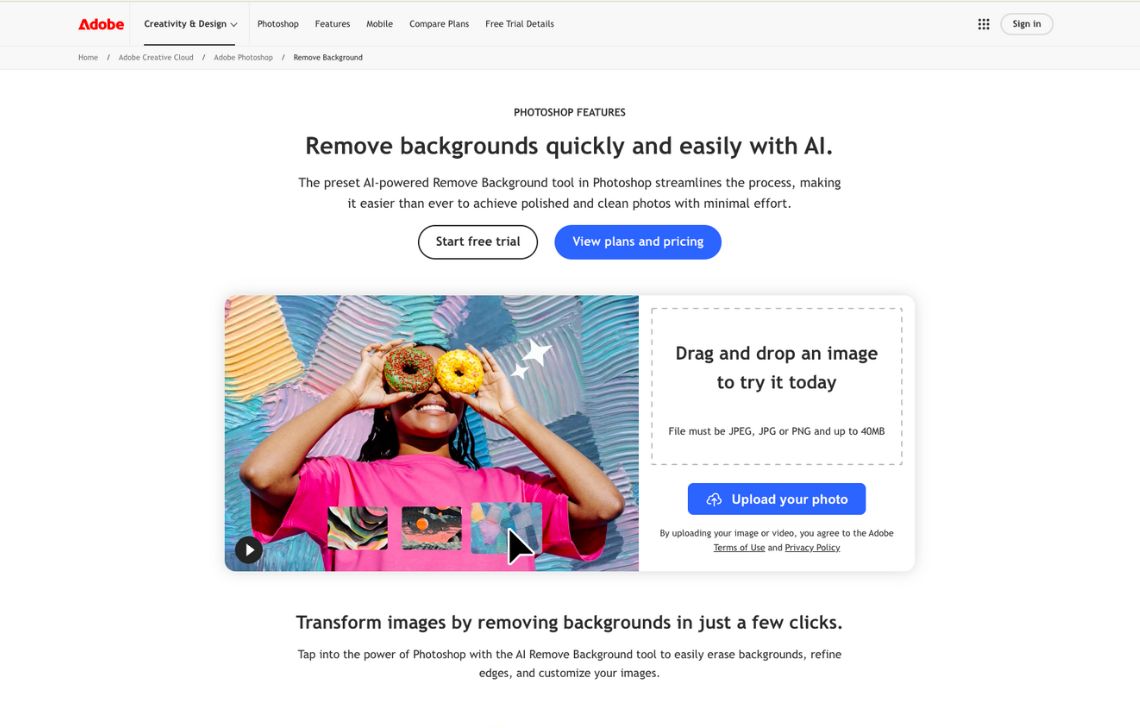
Adobe is also more scalable than the desktop application alone suggests. Larger teams can automate repetitive edits across high volumes of images, helping them create consistent product cutouts and campaign variations without opening every file in Photoshop.
This makes Adobe a practical option for businesses that already rely on Creative Cloud and want to extend familiar editing standards into automated production.
Key features
- Free automatic removal in Express
- Professional mask refinement
- Generative reconstruction
- Photoshop Actions (repetitive corrections and export steps can be recorded and applied across multiple files)
- Enterprise API
Best for
- Retouchers, designers, and agencies
- High-value hero images requiring manual inspection
- Existing Creative Cloud teams
Pricing
- Adobe Express Free: $0
- Adobe Express Premium: $9.99/month
- Adobe Firefly Pro: $19.99/month, including Express Premium and Photoshop on web and mobile
- Photoshop: $22.99/month with an annual commitment billed monthly
- Firefly Services and Photoshop API priced individually
Verdict
Adobe offers the deepest correction and compositing control in this list. It is less economical for straightforward bulk cutouts unless an organization already uses Adobe’s enterprise creative infrastructure.
6. Pixelcut, for small sellers with room to grow
Pixelcut combines a straightforward background remover with image upscaling, generative fill, background creation, object removal, and batch exports. It suits sellers who begin with a visual app but may later need team access or API automation.
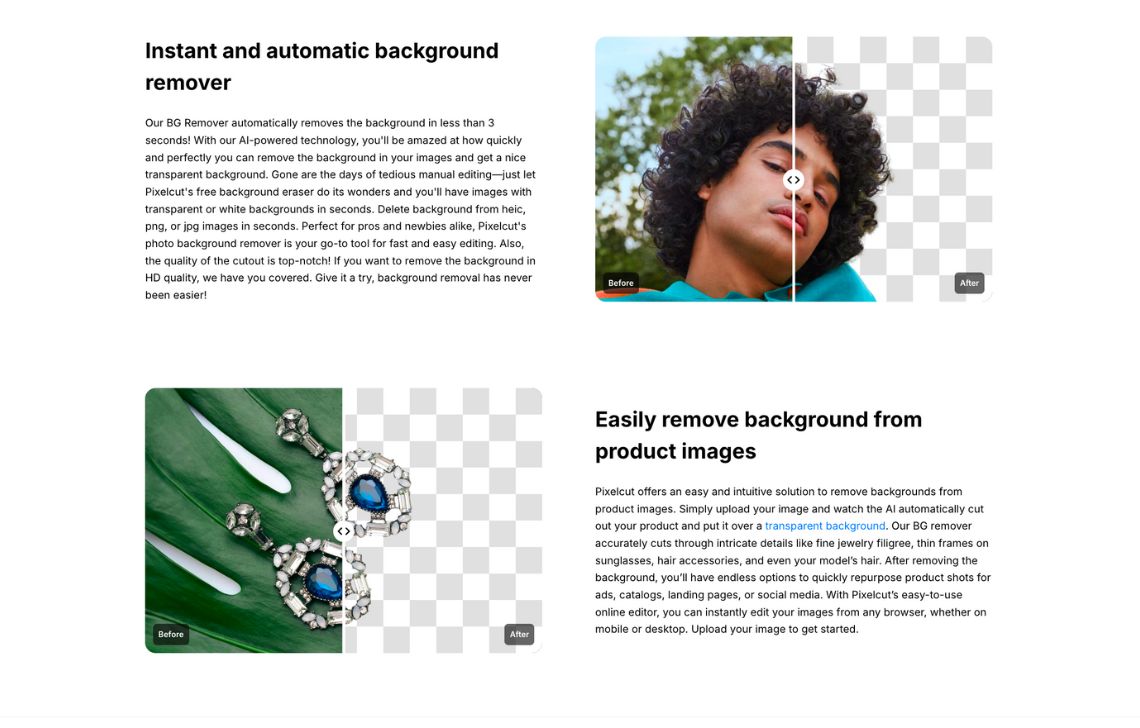
The Pro plan includes three team members and 1,000 monthly batch exports, while Business expands access to ten members and 2,000 batch exports. Its API is billed separately by credits.
Pixelcut’s background-removal endpoint costs five credits, or $0.05 per successful image at the standard $0.01-per-credit rate. Published API packages reach one million credits per month, with volume pricing available above that level.
Key features
- Automatic cutouts
- Flexible outputs
- Connected AI image editor
- Batch exports
- Developer API
Best for
- Solo sellers and small ecommerce teams
- Social commerce creators
- Teams that need moderate batch volumes
Pricing
- Free plan with limited background removal
- Paid plans starting from $10 monthly or $8/month billed annually
- Background removal API: $0.05 per image
- Higher-volume API pricing is available by request
Verdict
Pixelcut has a clear progression from individual editing to moderate batch and API use. Larger catalogs may outgrow its standard batch allowances or require more extensive workflow customization.
7. Clipdrop, flexible browser-based AI utility
Clipdrop by Jasper AI includes background removal alongside cleanup, relight, upscaler, and other tools. It remains useful when a designer wants several focused AI operations without opening a full creative suite.
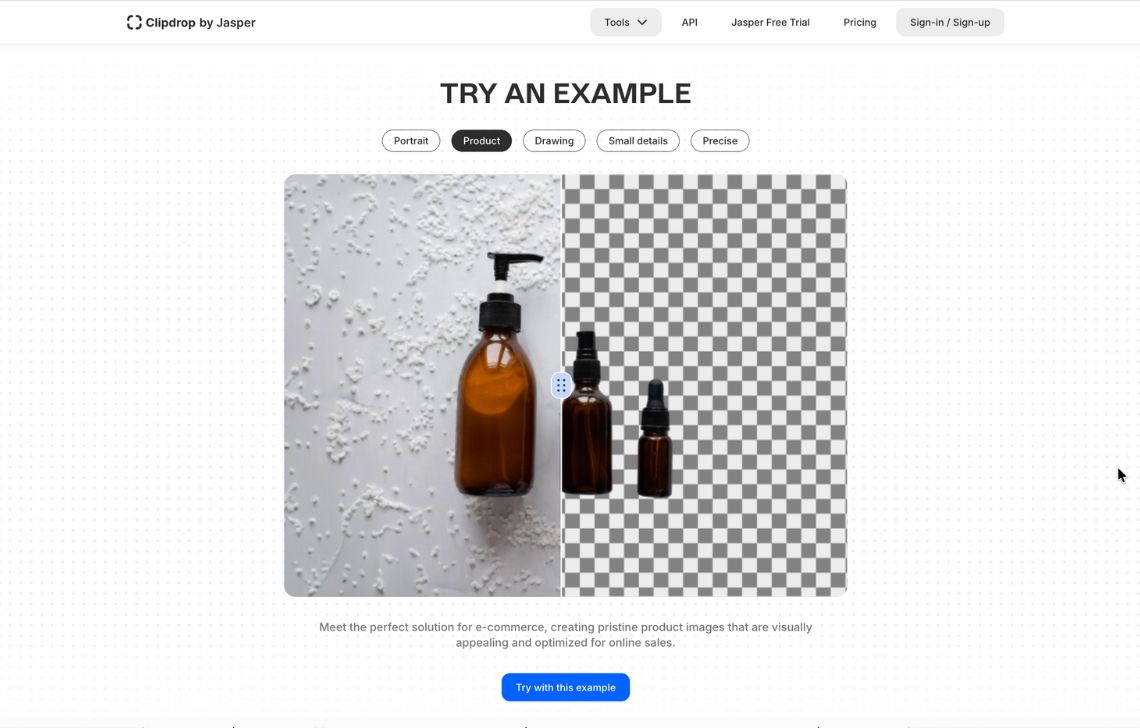
Its main advantage is the ability to move quickly from a cutout to other common corrections in the same browser-based workspace. Free users can process up to 20 background removals per day, while Pro raises the allowance to 1,000 high-resolution removals per day.
API access is available for automated workflows, with commercial pricing and additional capacity provided on request.
Key features
- High-resolution background removal
- Complementary repair tools
- Background generation
- API endpoint with PNG, WebP, and JPEG outputs
Best for
- Designers who need several quick browser tools
- Agencies handling varied image-repair tasks
- Users who value daily allowances more than catalog workflow controls
Pricing
- Free: 20 background removals per 24 hours
- Paid plans from $15 per month
- Custom API pricing
Verdict
Clipdrop remains a useful utility suite, but it is a weaker recommendation for new API buyers because packaging and pricing are less transparent than those of dedicated alternatives.
8. NoBG.space, free and private processing
NoBG.space runs its free background-removal model inside the user’s browser. Images are not uploaded, no account is required, and the result can be corrected with erase and restore brushes before downloading a transparent PNG.
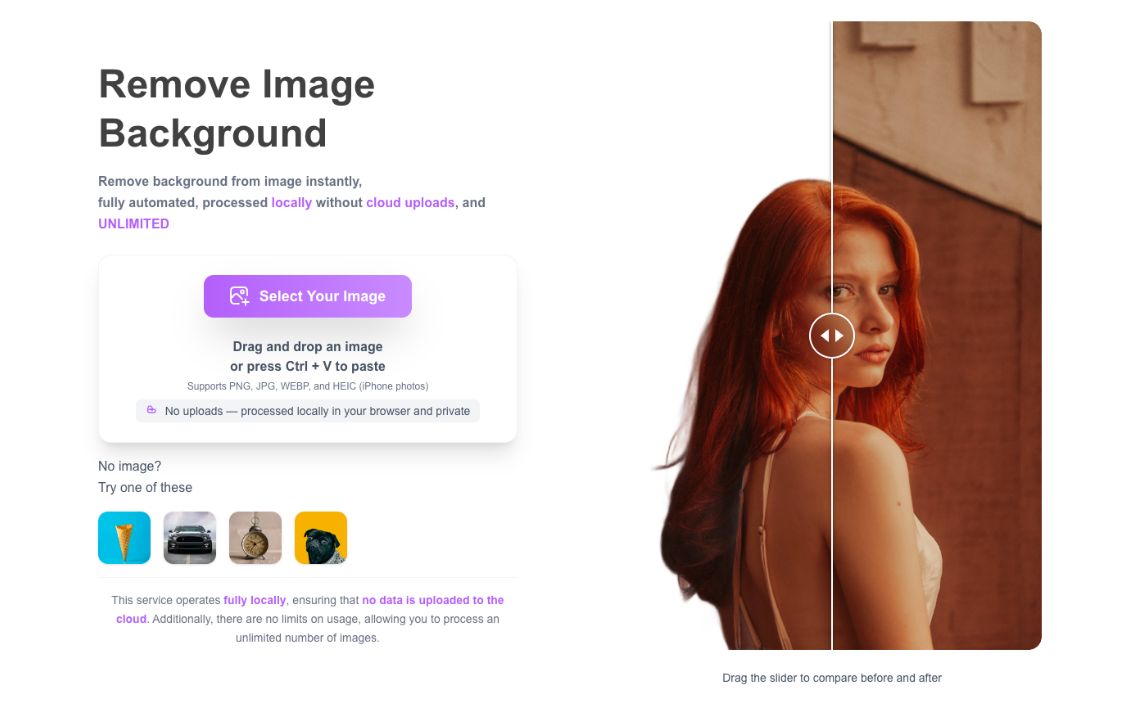
The browser tool also supports local bulk removal, making it useful for small private batches. Performance depends on the user’s device, so processing a large folder will not provide the predictable capacity, monitoring, or service guarantees of an enterprise cloud platform.
NoBG now also offers a cloud API. It processes images in memory, does not write them to disk, and charges only for successful requests. The published rate limit is 60 requests per minute.
Key features
- On-device inference
- Local bulk removal
- Manual corrections (brush tools)
- Full-resolution API
Best for
- Users handling confidential or unreleased assets
- Individuals who want free removal without an account
- Small teams processing occasional local batches
Pricing
- Browser background remover: free
- 50 free API credits
- Paid API: $0.01 per successful image
Verdict
NoBG offers an unusually strong combination of local privacy and inexpensive API access. Its limitations are the absence of enterprise support, advanced catalog controls, and broader product-photography workflows.
9. withoutBG, open and self-hosted option
withoutBG offers both an Apache-2.0 open-weight model and a managed background-removal API. Developers can run the open model through Python, Docker, a macOS application, or a local REST endpoint.
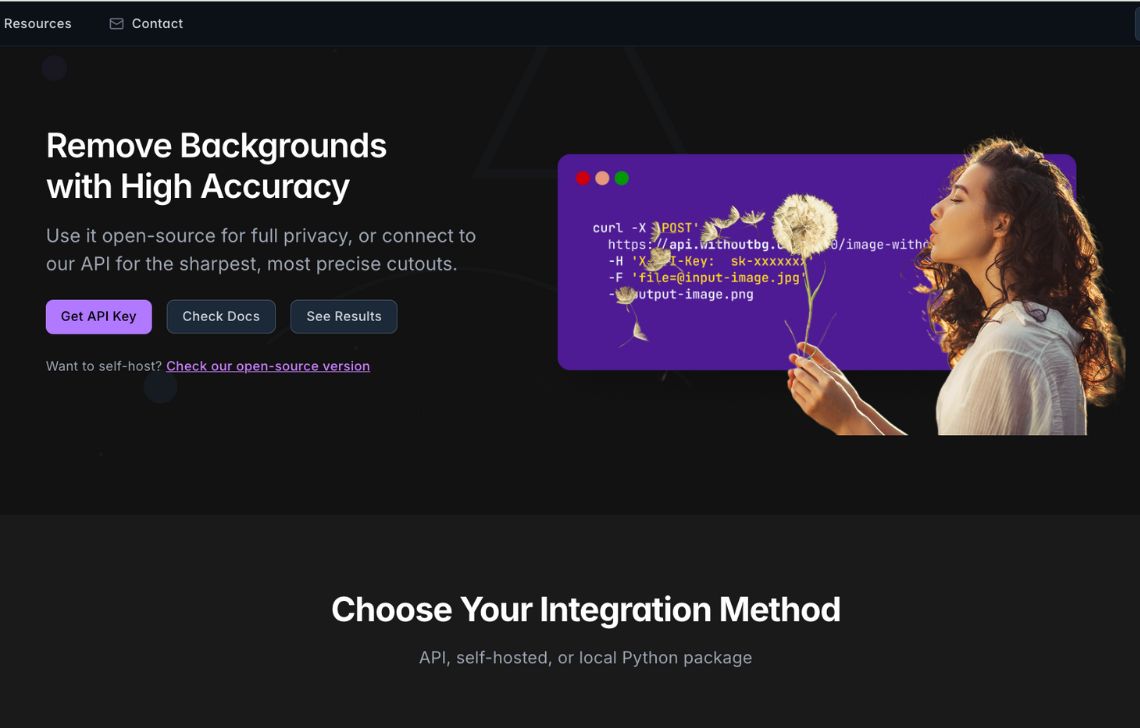
Self-hosting gives an organization control over where images are processed and how much capacity is provisioned. It can also eliminate per-image SaaS fees, but compute, monitoring, deployment, model updates, and reliability become the organization’s responsibility.
The managed Pro API runs in Frankfurt, processes images in memory, and discards them after the response. Both hosted and self-hosted versions can return transparent cutouts or alpha mattes.
Key features
- Open-weight model
- Several deployment options
- Compatible cloud and local schemas
- Alpha-matte output
- Privacy-focused managed API
Best for
- Engineering teams that require self-hosting
- Organizations that cannot send images to a general SaaS platform
- Developers building background removal into another product
Pricing
- Free open-weight model and self-hosted tooling
- Managed API: 50 free credits
- Credit packs start at €10 (~$11.20) for 100 images
Verdict
withoutBG provides the most deployment control in the list. Its total cost depends on engineering and infrastructure requirements, and it does not offer the turnkey ecommerce workflows or enterprise support of commercial catalog platforms.
How to choose the right background removal tool
A useful evaluation should test not only whether a tool can create a clean cutout, but whether it can support the complete volume, quality, privacy, and delivery requirements of your workflow.
1. Start with the intended output
If you only need a transparent PNG for a presentation or social graphic, Canva, Adobe Express, Pixelcut, Clipdrop, or NoBG may be sufficient.
For product listings, determine whether the output also needs a white background, exact dimensions, standardized padding, shadows, marketplace-safe margins, or enhancement. Claid and Photoroom are better aligned with this broader workflow.
2. Test the most difficult images
Build a representative evaluation set containing:
- Hair, fur, fabric, feathers, and other fine edges
- Glass, translucent packaging, reflective surfaces, and transparent plastic
- Jewelry, cables, bicycle spokes, and narrow product components
- White products against white backgrounds
- Low-resolution seller uploads
- Images containing props, hands, mannequins, or several potential foreground subjects
Measure how many results can be published directly, how many need a quick correction, and how many fail completely. Average processing cost is less meaningful than cost per approved image.
3. Compare workflow depth
Map every operation required between the source upload and the published asset:
- Remove or blur the original background.
- Select the correct subject.
- Standardize the aspect ratio, crop, padding, and alignment.
- Apply a transparent, white, colored, or generated background.
- Add a shadow or reflection.
- Enhance lighting, resolution, and sharpness.
- Validate the output.
- Export it to the required channel.
A lower-priced remover may become more expensive if operators must move every result through several other tools.
4. Check privacy and deployment requirements
For confidential assets, determine whether the tool stores files, uses uploads for training, supports regional processing, or offers contractual data controls.
NoBG’s local tool and self-hosted withoutBG keep images on the user’s infrastructure. Enterprise cloud platforms may be easier to operate but should be assessed for retention policies, encryption, compliance, access controls, and security reviews.
5. Evaluate the real scale path
“Batch processing” can mean anything from editing 50 files in a folder to processing millions of images through an API. Ask each vendor for:
- Tested images per minute and supported concurrency
- File-size, resolution, and format limits
- Behavior when a quota or credit balance is exhausted
- Queue priorities and peak-load handling
- Retry, webhook, and failure-reporting support
- Quality scores or automated review routing
- Higher rate limits and volume discounts
- SLAs, support response times, and incident procedures
- SSO, SCIM, audit logs, roles, and approval controls
- Custom models, brand rules, or category-specific processing
- Self-hosted or regional deployment options
Run a volume test using a realistic catalog batch before committing. A tool that performs well on ten images may behave differently when several thousand files arrive together.
6. Model the total cost
Compare tools using the same monthly image volume and include:
- Subscription charges
- API operations
- Credits consumed by reruns
- Batch export limits
- Generative background or enhancement costs
- Manual review and correction time
- Integration and maintenance work
- Infrastructure expenses for self-hosted models
- Enterprise minimum commitments
This produces a more useful figure than comparing entry-level monthly prices.
Need background removal at production scale?
Use Claid’s background removal API to automate cutouts, padding, resizing, enhancement, and background replacement, or talk to our team about a custom workflow with specific quality rules and dedicated support.
FAQ
What is the best background removal tool for ecommerce?
Claid is the strongest fit when a business needs background removal combined with resizing, padding, enhancement, background generation, and custom workflows. Photoroom is a strong option for sellers who prefer a visual editor, templates, and simpler batch processing.
What replaced remove.bg in this comparison?
Slazzer fills the dedicated background-removal role with a REST API, desktop batching, plugins, published throughput limits, on-premise deployment, and enterprise plans. Canva remains in the list because remove.bg’s functionality is being migrated into the broader Canva platform.
What is the best free background remover?
NoBG.space is the strongest privacy-first option because it processes images locally without uploads or an account. Adobe Express and Pixelcut also provide accessible free removal for individual images, while Canva allows one free trial use.
Which tools provide background-removal APIs?
Claid, Slazzer, Photoroom, Adobe Firefly Services, Pixelcut, Clipdrop through Jasper, NoBG, and withoutBG offer API options. Their pricing, workflow depth, rate limits, and enterprise support differ substantially.
Which background remover can be self-hosted?
withoutBG provides an Apache-2.0 open-weight model that can run through Python, Docker, or a local API. Slazzer also offers an on-premise commercial deployment for enterprise customers.
Can background removal be automated for an entire catalog?
Yes. Claid, Slazzer, Photoroom, Adobe Firefly Services, Pixelcut, and several developer-focused options support automated processing. For large catalogs, test the complete workflow with other operations.
Need this at scale or as a custom workflow?
Handle background removal at scale without adding manual work to your team. Automate the process through our API, or let our team manage it for you.


Claid.ai
October 15, 2026