Tech
8 best AI image upscalers for clean-looking product photos in 2026


Low-resolution images can make listings, ads, and printed materials look unprofessional. AI upscalers enlarge images while reconstructing edges, textures, and other details that ordinary resizing cannot recover.
This 2026 guide compares eight free and paid AI image upscalers, including browser tools, desktop software, creative enhancers, APIs, and enterprise options.
Quick comparison of the best AI image upscalers
Pricing and features may change, so confirm the latest plan details on each provider’s website before purchasing.
| Tool | Best for | Pricing |
|---|---|---|
| Claid | Ecommerce product photos and catalog workflows | Free trial; from $9/month |
| LetsEnhance | General photography, restoration, and print | 10 free credits; from $9/month |
| Topaz | Detail-critical photography and professional finishing | Gigapixel from $19/month |
| Magnific | Creative upscaling and detail generation | Limited free access; from $14.50/month |
| Pixelcut | Mobile sellers and lightweight ecommerce editing | Free plan; from $8/month |
| Upscale.media | Simple browser upscaling and API processing | Free plan; pay-as-you-go from $5.99; annual subscription from $69.99 |
| Nero AI | General enhancement and restoration tools | 10 free credits; from $9.66/month |
| Upscayl | Free local upscaling and privacy-sensitive work | Free desktop app; Cloud from $9.99/month |
Need AI upscaling at scale?
Improve quality and realism across your catalog. Automate enhancement through our API, or choose a custom solution designed around your workflow.
1. Claid, AI upscaler for ecommerce
Claid is an ecommerce-focused image platform that combines AI upscaling with product-photo generation, and catalog preparation. It can remove a background, correct lighting, standardize the crop, generate a new scene, and upscale the finished image within the same tool.
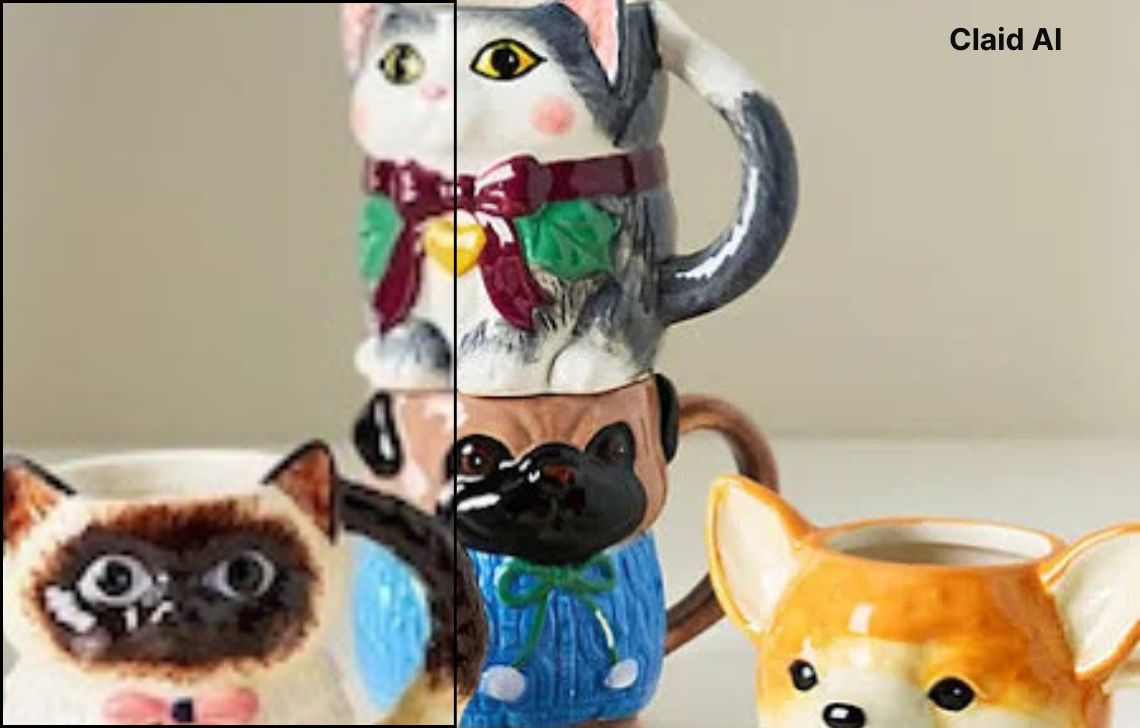
Its enhancement models are designed to recover resolution while keeping commercially important details such as labels, garment textures, logos, and product edges intact.
For enterprise catalogs, Claid provides an upscaling API, as well as other APIs for relevant image operations. You can also request custom-built workflows tailored to your requirements. A pipeline can inspect each source image, select the required enhancement operations, apply marketplace-specific dimensions, flag unsuitable inputs, and return the finished asset to the correct SKU.
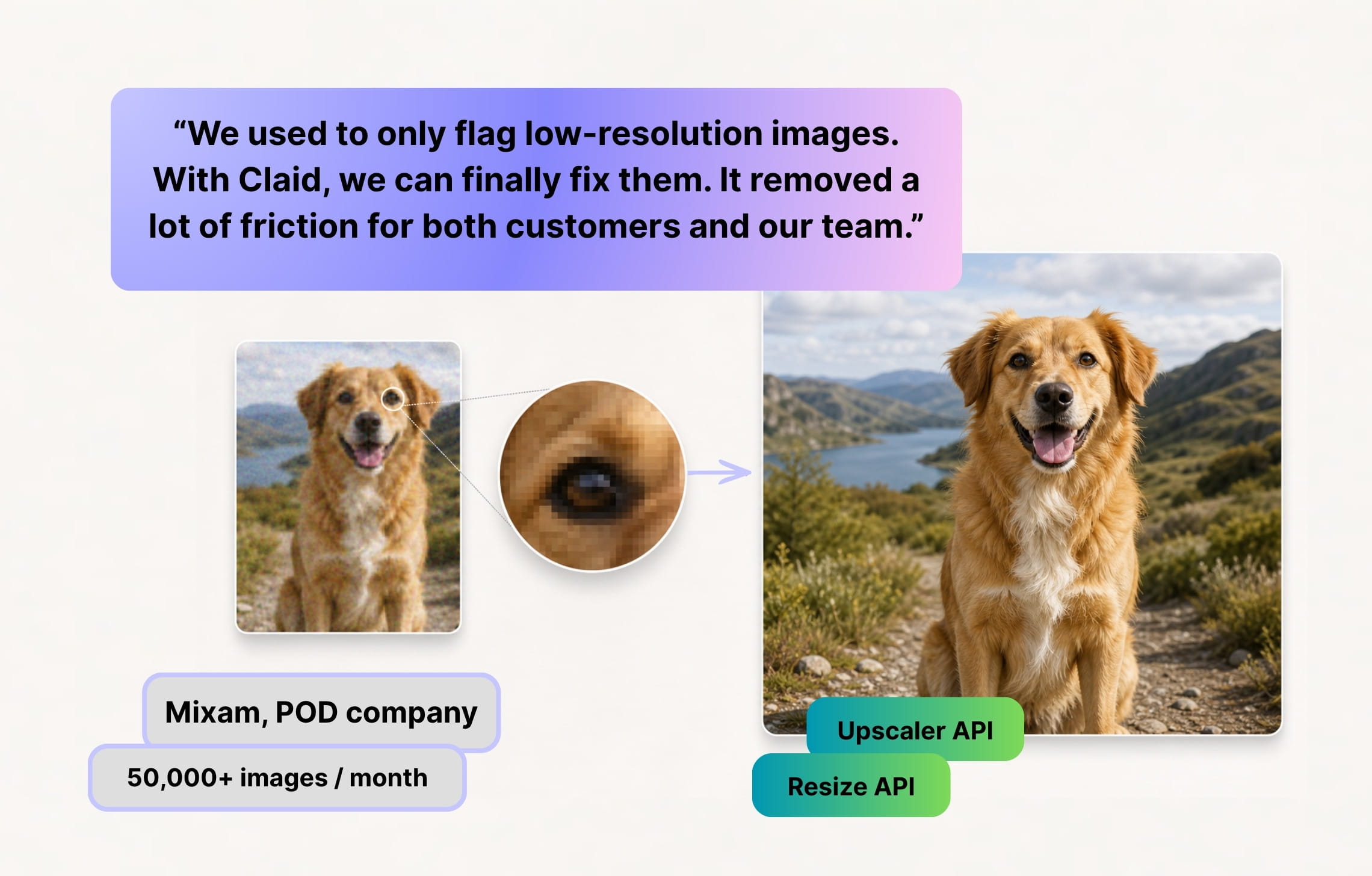
With Claid AI, a printing company Mixam upscaled low-resolution artwork to print-ready files and reduced quality complaints by 78%, while a marketplace Zepto improved image quality and consistency across a catalog of more than 45,000 products.
Key features
- x2 and x4 AI upscaling with several enhancement modes
- Support for product photos, portraits, text-heavy images, and digital art
- Noise, compression, and artifact cleanup
- Photo cleanup tools within the platform (background removal, object removal, relighting, etc.)
- Generative resizing and outpainting for new aspect ratios
- Product-background and lifestyle-scene generation
- API access for automated catalog processing
- Custom and managed workflows for large image volumes
Best for
- Ecommerce teams improving low-resolution supplier images
- Marketplaces standardizing assets from many sellers
- Businesses combining upscaling with other product-image operations
Pricing
- Free trial with 50 credits
- Paid plans from $9 per month
- Custom enterprise pricing
Pros
- Built specifically around ecommerce imagery
- Combines enlargement with full catalog preparation
- Provides a managed option for teams that do not want to operate the workflow themselves
Cons
- Not the best choice for occasional users who need upscaling only
2. LetsEnhance, all-round online AI photo upscaler
LetsEnhance is a browser-based upscaler for photography, restoration, digital art, and print preparation. It occupies the middle ground between simple one-click tools and detailed desktop software.
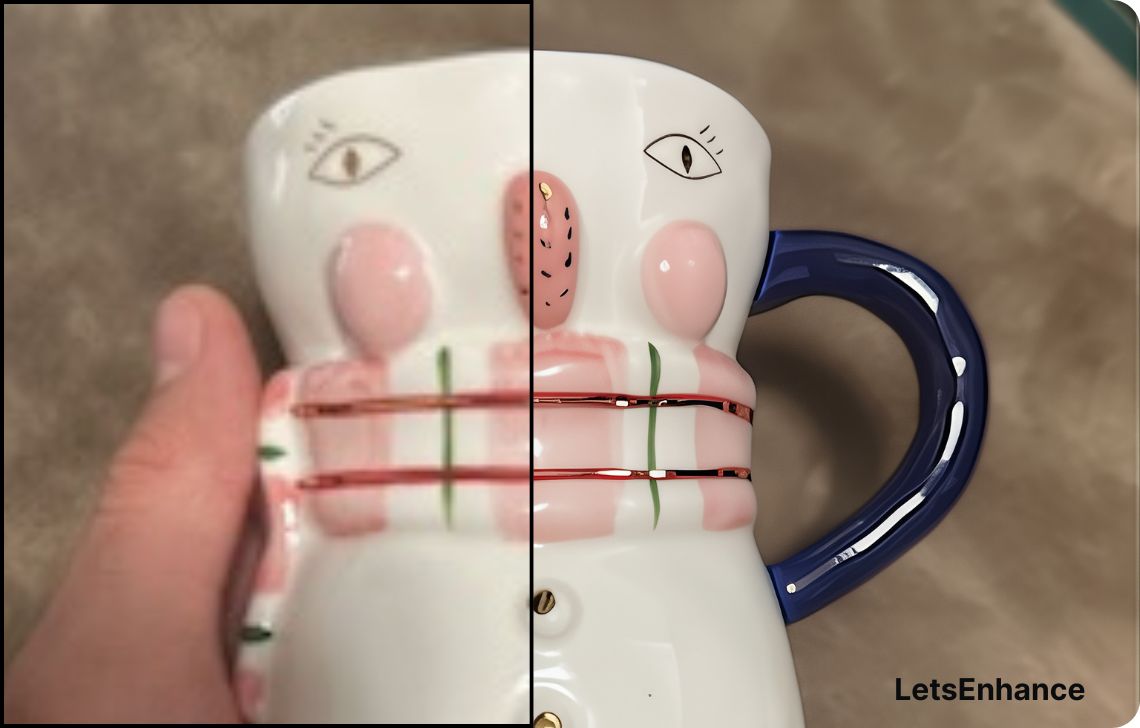
Users can choose enhancement modes based on the source material, control how aggressively the image is changed, remove compression artifacts, and prepare files for specific print dimensions. Output limits extend into hundreds of megapixels on paid plans, which makes the tool useful for posters and other large-format assets. LetsEnhance also includes batch processing, background removal, and AI-generation features.
For larger teams, business plans support 1,000–5,000 monthly image credits and output up to 500 megapixels. Companies needing more volume or resolution can request a custom arrangement.
Key features
- Upscaling up to x16
- Multiple enhancement modes for photos, digital art, and restoration
- Noise and JPEG artifact reduction
- Print presets for common paper and poster sizes
- Batch image processing
- Adjustable enhancement strength
Best for
- Marketers and photographers who want a flexible browser tool
- Creators preparing images for print
- Small businesses that need regular batches without desktop software
Pricing
- 10 free credits
- Paid plans from $9 per month
- Custom pricing for large volumes
Pros
- Good balance of usability and control
- Strong output-resolution limits
- Useful restoration and print tools
Cons
- Results depend heavily on selecting the correct mode
- No ecommerce-specific catalog orchestration
3. Topaz, AI upscaler for detail-critical photography
Topaz offers several overlapping products for professional image enhancement. Gigapixel focuses on enlargement and detail recovery, while Topaz Photo combines upscaling with denoising, sharpening, face recovery, lighting correction, and other repairs. Topaz Studio bundles the company’s image, video, desktop, mobile, and web applications.

Gigapixel provides models for high-fidelity photos, low-resolution inputs, text and shapes, computer-generated art, faces, and more creative reconstruction. Topaz Photo is more appropriate when the source has several defects that need to be corrected together.
For professional organizations, Topaz has separate Pro licenses. These add full commercial usage rights, higher limits, pro models, and seat-management capabilities. Local batch processing is useful when teams have powerful workstations or cannot upload unreleased assets, although Topaz is less suited to headless ecommerce automation than an API-first platform.
Key features
- Specialized enlargement models for different image types
- Face recovery and portrait enhancement
- Models designed to preserve text and geometric shapes
- Local desktop rendering
- Photoshop and Lightroom workflow support
Best for
- Photographers and retouchers inspecting images at full resolution
- Print studios working with demanding enlargements
- Teams restoring faces, textures, or fine photographic detail
Pricing
- Topaz Gigapixel: $19 per month with annual billing or $29 monthly
- Topaz Photo: $25 per month with annual billing or $39 monthly
- Topaz Studio: $45 per month with annual billing or $69 monthly
- Topaz for Web: starts at $19 per month
- Professional plans cost more and are required for certain larger commercial organizations
Pros
- One of the highest quality ceilings for photographic detail
- Extensive control over model selection
- Supports both local and cloud rendering
Cons
- Subscription pricing is relatively high
- It lacks a straightforward catalog API comparable with ecommerce-focused platforms
4. Magnific, creative upscaling
Magnific is a creative upscaler that can add new texture and detail rather than only enlarging the information already present. This makes it useful for advertising concepts, stylized product scenes, digital artwork, and generated imagery that benefits from a richer high-resolution finish.
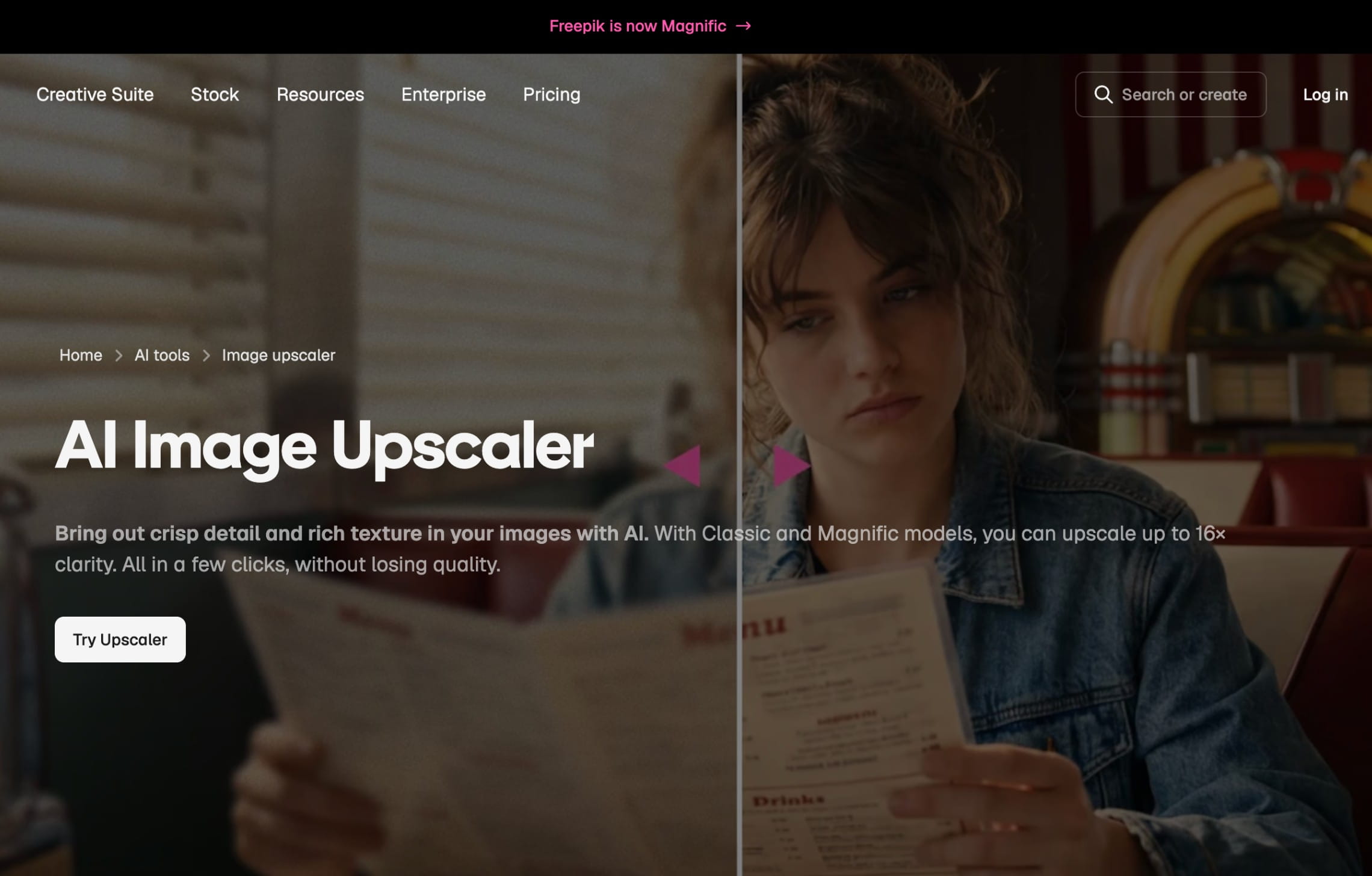
The same behavior makes it riskier for strict ecommerce packshots. A creative upscaler may replace ambiguous pixels with visually convincing details that are not present on the physical product. Labels, stitching, material texture, and small construction features require close inspection.
Magnific’s tools are now part of the broader Freepik/Magnific creative platform. The subscription includes access to image-generation models, stock content, editing tools, shared Spaces, and Magnific’s image and video upscalers.
Key features
- Creative upscaling that reconstructs and enriches detail
- Prompt controls for directing the enhanced result
- Adjustable creativity and resemblance settings
- Image enhancement and restoration
- Support for generated artwork and stylized photography
- Access to stock assets and additional generative models
- API access through paid plans
Best for
- AI-generated product concepts and lifestyle scenes
- Digital art, illustrations, and campaign imagery
- Teams that already use the Freepik/Magnific creative ecosystem
Pricing
- Limited free access is available
- Paid plans from $14.50 per month
- Custom enterprise pricing
Pros
- Excellent for adding visual richness to generated or stylized images
- More creative control than conventional upscalers
- Team workspaces and API access support larger creative operations
Cons
- Can invent details that misrepresent a physical product
- Requires stricter QA when labels, textures, or geometry affect purchasing decisions
5. Pixelcut, upscaler for mobile sellers and social content
Pixelcut combines a simple image upscaler with background removal, generative backgrounds, object removal, image expansion, and other lightweight ecommerce tools. Its web and mobile interfaces are intended for users who want a fast result without learning professional editing software.
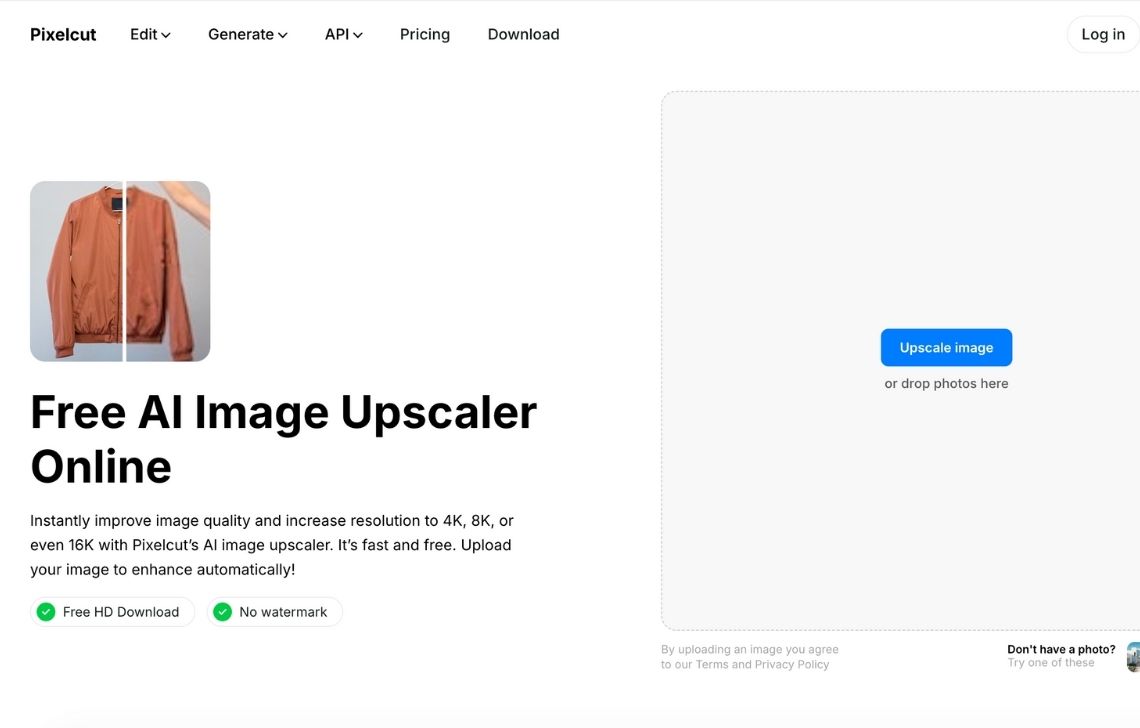
The upscaler is appropriate for social posts, marketplace images, thumbnails, and routine storefront assets. It offers less technical control than Topaz, but the surrounding tools make it convenient for sellers who also need to clean and reformat their images.
Pixelcut becomes more relevant to teams through its Business plan, which includes ten seats, larger credit allowances, and 2,000 monthly batch exports. Its API supports upscaling and other image operations, with published credit bundles up to one million credits and volume pricing beyond that point.
Key features
- Fast AI upscaling
- Background removal
- Generative backgrounds
- Magic Eraser and object removal
- Image expansion
- API for upscaling and related operations
Best for
- Mobile sellers and small ecommerce teams
- Marketplace listings and social content
- Teams that want several basic image tools in one interface
Pricing
- Limited free plan
- Paid plans from $8 per month
- Custom enterprise pricing above 1M credits per month
Pros
- Easy for non-designers
- Useful combination of upscaling and listing tools
- Business and API options provide room to grow
Cons
- Designed more for speed than image accuracy
- Large catalogs still need an external workflow and QA layer
6. Upscale.media, simple browser and API upscaler
Upscale.media is a focused browser upscaler for quick x2 and x4 enlargement. Users can process an occasional image without creating an account or sign up for monthly free credits.
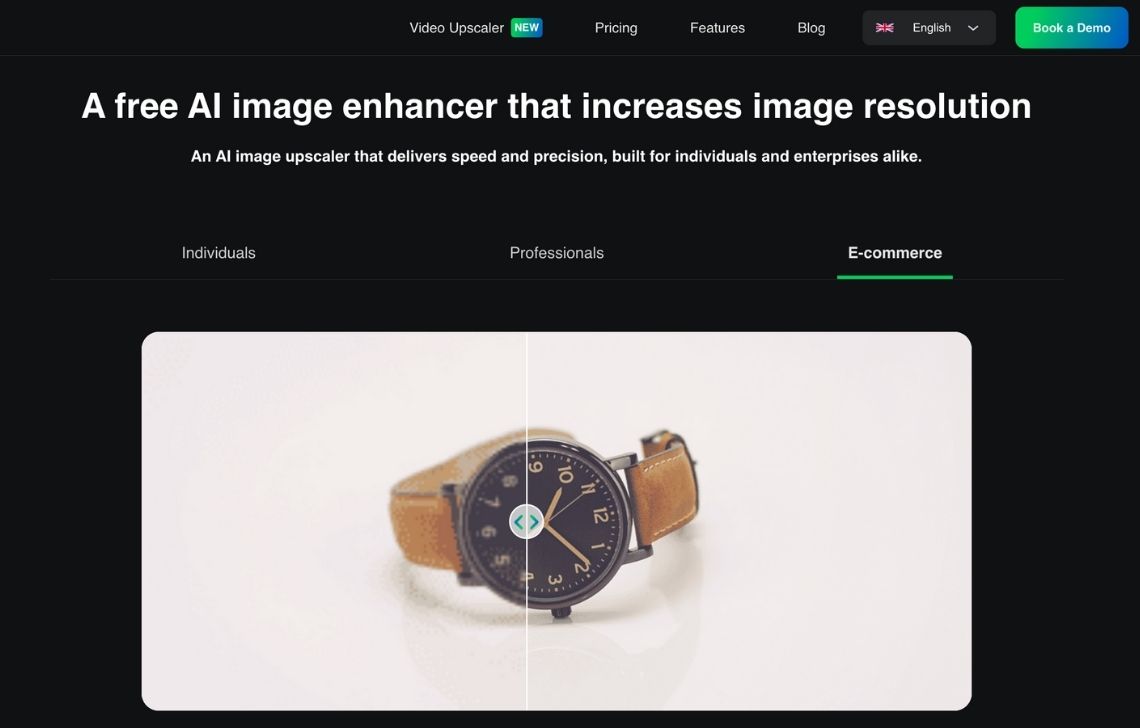
The product is part of the Pixelbin ecosystem, which adds background operations, bulk transformations, and reusable presets. That makes it more useful to ecommerce teams than the simple consumer interface initially suggests.
Businesses can combine upscaling with background removal or replacement, apply the resulting preset to batches, and integrate the same transformations through an API. Enterprise customers can request custom pricing, support, and processing arrangements.
Its main limitation is differentiation. The basic upscaler is convenient, but its quality controls and subject-specific models are less extensive than those offered by Topaz, Claid, or LetsEnhance.
Key features
- x2 and x4 image upscaling
- Browser-based processing
- Background removal and replacement
- Bulk transformations through Pixelbin
- Reusable transformation presets
- API integration
Best for
- Occasional browser-based enlargement
- Teams already using Pixelbin transformations
- Businesses that want pay-as-you-go credits instead of a large subscription
Pricing
- Users can upscale one image per day without signing up, while registered free accounts receive three monthly credits
- Pay-as-you-go packs start at $5.99 for 60 credits, with 125 credits available for $9.99
- Enterprise plans are custom-priced
Pros
- Very little setup
- Flexible pay-as-you-go option
- Bulk presets and API access
Cons
- Fewer specialist models and controls
- Basic results may not justify adding another tool to an existing image stack
7. Nero AI, multi-tool image enhancer
Nero AI combines upscaling with face enhancement, restoration, sharpening, denoising, colorization, background removal, and other browser-based tools. Different upscaling models are available for photos, anime, general images, fine textures, and reconstruction.
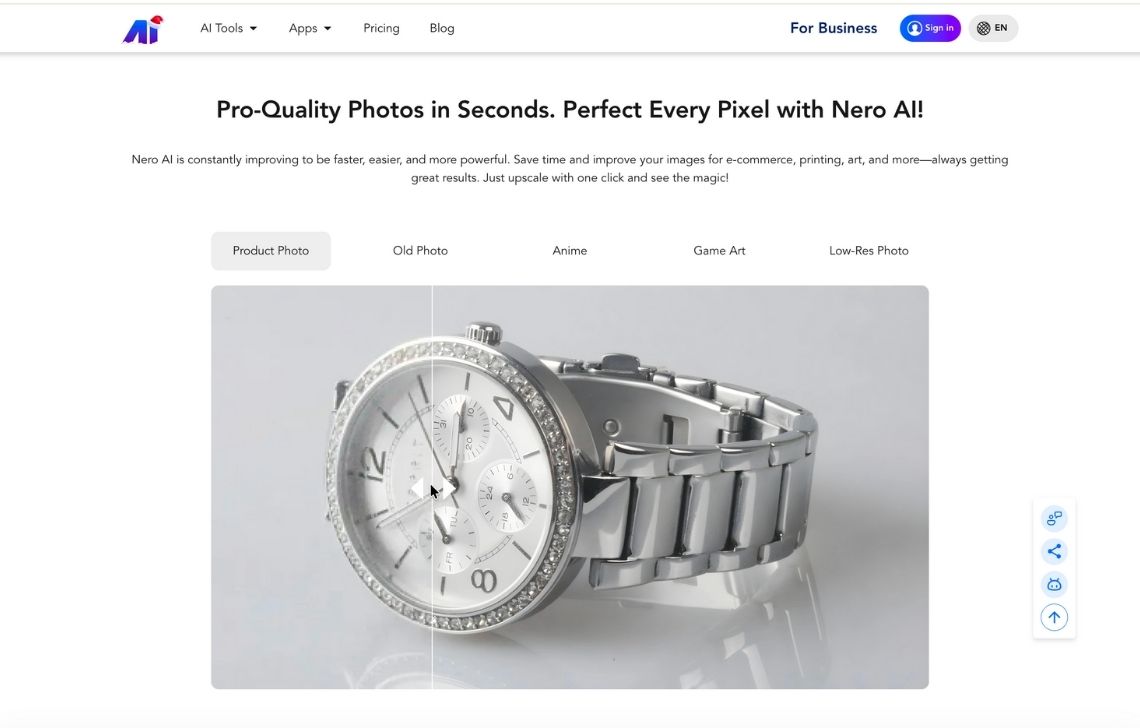
The shared credit system is convenient when one image needs several different fixes. It can also make costs harder to forecast because a standard x2 upscale, a reconstruction model, and an x8 enlargement consume different numbers of credits.
Nero supports batch processing for five images on the free plan and up to 30 on its standard paid plan. Business customers can process batches of up to 200 images and receive API access, custom credits, higher priority, and dedicated infrastructure.
That makes Nero viable for organizational use, particularly when restoration and general enhancement matter alongside upscaling. However, it lacks the ecommerce-specific routing and catalog controls of a platform such as Claid.
Key features
- x2, x4, and x8 enlargement
- Photo, anime, standard, fine-texture, and reconstruction models
- Photo restoration and colorization
- Sharpening, denoising, and unblurring tools
- API access for Business customers
- Custom credits and dedicated-server options
Best for
- Users who want several photo-repair tools in one account
- Restoration and enhancement of mixed image collections
- Real-estate, interior, and marketing imagery
Pricing
- 10 one-time credits
- Paid plans from $24.99 per month
- Custom enterprise pricing
Pros
- Broad set of enhancement tools
- Models for several image types
- Useful restoration capabilities
Cons
- Credit consumption varies significantly by model
- Not designed around catalog consistency or SKU-level workflows
8. Upscayl, free offline AI image upscaler
Upscayl is a free, open-source desktop upscaler for Windows, macOS, and Linux. It runs locally, supports several enhancement models, and can process image batches without uploading them to a third-party server.

Local operation makes it attractive for unreleased products, client assets, and other privacy-sensitive work. It also removes per-image charges, provided the computer has compatible hardware and sufficient processing capacity.
Upscayl Cloud provides a browser alternative for users without a suitable GPU. Cloud plans support larger outputs, credit rollover, storage, and higher-volume business tiers.
For enterprise use, the local app can be deployed as part of a controlled workstation process, while Cloud offers Business plans from 1,000 to 5,000 monthly credits and custom volumes above that. However, Upscayl does not provide the same centralized catalog rules, review system, or ecommerce workflow management as a dedicated enterprise platform.
Key features
- Free and open-source desktop application
- Local image processing
- Multiple upscaling models
- Folder and batch processing
- Adjustable scale factors
- Output format and location controls
Best for
- Privacy-sensitive images
- Technical teams comfortable managing desktop software
- Businesses that need straightforward cloud volume without a broader editing platform
Pricing
- The desktop application is free and open source
- Upscayl Cloud includes 10 trial credits and starts at $9.99 per month for 100 credits
- Business plans start at $79.99 for 1,000 monthly credits
- Custom plans are available
Pros
- No subscription or per-image cost for desktop use
- Images can remain on the local computer
- Cloud service now has an affordable $9.99 entry tier
Cons
- Local performance depends on hardware
- Results can be inconsistent on heavily compressed inputs
How to choose the right AI image upscaler
The best AI image upscaler depends on your source images, quality standards, processing volume, privacy requirements, and how the tool needs to fit into your production workflow.
Here’s how to choose the most suitable one for your needs.
1. Start with the type of image
Different inputs fail in different ways.
For ecommerce product photos, prioritize label preservation, edge quality, accurate texture, and consistent output dimensions. Claid is the strongest workflow-oriented choice, while Topaz is useful when a retoucher will inspect and finish each important image.
For general photography and print, LetsEnhance and Topaz provide more control over resolution, restoration, and sharpening.
For generated art and campaign concepts, Magnific can add compelling new detail. Avoid using highly creative enhancement on accuracy-critical packshots without close review.
For fast marketplace and social images, Pixelcut or Upscale.media may be sufficient.
2. Decide whether you need precise or creative upscaling
A precise upscaler tries to preserve the source while increasing resolution and cleaning artifacts. This is normally the safer choice for packaging, apparel, jewelry, and technical products.
A creative upscaler reconstructs or invents additional visual detail. It can improve stylized work, but it may also change material texture, lettering, product geometry, or small design elements.
Use Claid, LetsEnhance, Topaz’s conservative models, Upscale.media, or Upscayl for more controlled enlargement. Use Magnific when richer interpretation is an intentional part of the creative direction.
3. Compare cloud and local processing
Choose local processing when:
- Images are confidential or unreleased
- Your team has suitable hardware
- You want unlimited processing without per-image credits
- Files are too large or numerous to upload efficiently
Topaz and Upscayl are the main local options in this comparison.
Choose cloud processing when:
- Several people need access
- You want to avoid workstation requirements
- Images arrive through a website, catalog, or seller portal
- You need APIs or centralized processing
- The workflow must run without a designer opening an application
Claid, LetsEnhance, Pixelcut, Upscale.media, Nero, and Magnific provide cloud-based paths.
4. Evaluate enterprise requirements before comparing image quality
At enterprise scale, a visually strong result is only one requirement. Ask whether the system can:
- Accept images automatically through an API
- Process large batches without manual uploads
- Apply different rules by category, seller, marketplace, or SKU
- Preserve product labels, colors, and geometry
- Route exceptions to human review
- Return outputs to the correct catalog record
- Provide team permissions and usage reporting
- Meet security, support, and service-level requirements
- Offer predictable volume pricing
- Handle retries and failed inputs without stopping a batch
Claid is the most complete ecommerce workflow option in this list. Pixelcut, Upscale.media, and Nero offer APIs that can become part of a custom pipeline. LetsEnhance supports larger cloud batches. Topaz and Upscayl are stronger for controlled local processing, while Magnific’s enterprise strengths are centered on collaborative creative production.
5. Calculate cost per approved image
Do not compare tools using only the subscription price. Include:
- Credits consumed by each enhancement mode
- Failed outputs and retries
- Retouching time
- Manual file handling
- Integration work
- Quality review
- Storage
- Additional seats
- Commercial-license requirements
- API or enterprise premiums
A free desktop tool can be economical when an operator processes occasional batches. It may become expensive when employees spend hours renaming, reviewing, and routing thousands of files.
Conversely, a higher-priced API workflow may lower the final cost if most outputs reach the correct SKU ready to publish.
6. Run a representative pilot
Test the shortlisted tools using the same source files. Include:
- A clean but undersized packshot
- A highly compressed supplier image
- Packaging with small text
- Reflective or transparent material
- Patterned fabric
- A face
- An illustration or generated image
- At least one unusually difficult SKU
Inspect the results at 100% magnification. Score label accuracy, edge quality, texture, color, artifacts, processing time, file size, and the percentage of outputs that can be published without manual correction.
For enterprise evaluation, run a complete batch through ingestion, processing, review, naming, and catalog delivery. A strong sample image does not prove that a tool can support production.
7. Check pricing and commercial terms
Credit systems are flexible, but costs can vary by model and resolution. Subscriptions are easier to forecast when volume is stable. Local tools avoid processing charges but require compatible hardware and internal operation.
Also check licensing carefully. Some individual plans restrict commercial use based on organization size. Enterprise customers may need a Pro, Business, or negotiated license even when the software technically works on a cheaper plan.
FAQ
What is an AI image upscaler?
An AI image upscaler predicts the additional pixels required to enlarge an image. Instead of stretching the original pixels, it reconstructs edges, textures, and details while often reducing noise or compression artifacts.
What is the best free AI image upscaler?
Upscayl is the strongest option for unrestricted local use because its desktop application is free and open source. Pixelcut and Upscale.media are easier for occasional browser-based upscaling, but their free tiers have usage limits.
What is the best AI image upscaler for ecommerce?
Claid is the strongest choice when upscaling is part of a larger ecommerce workflow involving background removal, standardization, resizing, generation, or API automation.
Topaz is a strong choice for manually reviewed hero images. Pixelcut and Upscale.media are suitable for faster, less complex listing workflows.
What is the best upscaler for portraits and faces?
Topaz provides detailed face-recovery controls and several photographic models. LetsEnhance supports portrait and restoration workflows, while Nero combines face enhancement with broader restoration tools.
Creative tools such as Magnific can add convincing facial detail, but the result may not be a faithful reconstruction of the original person.
Can an AI upscaler restore genuinely missing details?
No upscaler can recover information that was never captured. It can predict a plausible result based on patterns learned during training, but that result is not proof of the product’s true texture, text, or construction.
The smaller or more damaged the source, the more interpretive the output becomes.
How do I keep a product catalog consistent?
Use one approved model and preset for each product category. Standardize the input crop, output dimensions, sharpening strength, color rules, and file format.
For large catalogs, automate the sequence through an API or workflow: inspect the input, clean it, upscale it, validate the result, and return it to the correct SKU. Do not mix several upscalers randomly across the same catalog.
Are free AI upscalers safe for commercial work?
Check the commercial license, data-retention policy, output limits, and watermark rules. Local open-source software can reduce upload-related privacy concerns, but the business remains responsible for validating the output and the software license.
Paid Business or Enterprise agreements are generally more appropriate when sensitive assets, service guarantees, user permissions, or regulatory requirements are involved.
Need AI upscaling at scale?
Improve quality and realism across your catalog. Automate enhancement through our API, or choose a custom solution designed around your workflow.


Claid.ai
October 12, 2026